I had a very interesting day today shopping around for some stuff and it suddenly made me think of a very serious research area we need to look into here at DERI.
Looking back over today's adventures I realized that about 85% of the time, when I asked a question of a sales or service person here in Galway, the first answer I was given was incorrect.
These questions ranged from "is the item I ordered from Argos ready for pickup?" to "Do you have that in stock?", to "How many potato skins come in a small order?"
These were completely mundane questions and the sort of questions you would expect clerks, waiters, and service persons to know. However, in virtually every case, the FIRST answer given was incorrect. Analysis later (and some careful questioning of these folks) revealed that, largely, this was because they wanted to impart information, they wanted to be helpful, and in most case honestly believed the first answer was correct and were surprised to discover they were wrong. In one case the clerk was quoting a computer generated report and IT was wrong.
As I thought about this I suddenly realized that, if this is a cutltural phenomenon, it could be very important for issues of elearning, particularly assessment. In any culture where accuracy is sacrificed to answers, assessment of the efficacy of an elearning regime may need to take that into account to be effective and to properly reflect the state of the student.
So one very interesting research project would be to ask and answer the question,"How often is the FIRST answer to factual questions correct in a given culture/country/region?" Does it vary significantly with culture? Does it vary enough that it needs to be adjusted for in eLearning assessment strategies? Is this one more area where systems need to be contextually aware and make semantically powered adaptations?
Thoughts on this?
Bill
Saturday, September 16, 2006

Monday, July 17, 2006
Superman Returns
So here I am, hanging out in Galway
It's been a busy month here, but the new job is working out great and I have an apartment, (which overlooks Rusheen Bay, by the way and is exquisite) and I have settled in almost completely. Of course, I still have to go back to San Jose and finish crating and freighting.
But today I am insomiac, it's 3.30 am, and it's been a quiet, uncomplicated Sunday. So I'm writing this.
This afternoon I went out to see Superman Returns.
WOW. This is one of the best movies I have seen this year. The story is solid, the acting is excellent and Kevin Spacey makes a scary Lex Luthor.
But mostly I was impressed with the serious way the film dealt with what it means to be Superman. And the fact that the writers and director did not cop out and take the predictable characterizations and plot lines.
So, when characters act in unexpected ways and the plot develops along lines that are not as stagnantly predictable as most films these days, I am impressed.
I'm not sure I care for Routh in the part, however. His acting is fine but he looks odd for Superman...he has features that are too heavy and sharp. However, he is reminsicent of Chris Reeve and that seems to have been a plus for him.
So I definitely recommend seeing this film..it is solid and outstanding.
On other fronts, Galway is very beautiful. Recently the weather has been sunny and fair and warm. I'm learning where things are and what's available. Finally got the right bed in the apartment. I'm finding costs a bit higher than Dallas, but lower than San Jose.
Running the gauntlet of officaldom has been the biggest challenge...trying to get work permit, bank account, debit card, pin for debit card (was sent to california by mistake) and online access (pin also sent to california) has been the biggest frustration, but those are finally sorting themselves out. I await one more magic number from the formal officialdom of Ireland and then I think I am completely installed.
Even the Irish joke about how long things take in Ireland and how everything takes longer than you expect. The 4pm movie today didn't start the projector until 4.15. But all things come to those who wait.
From a standpoint of work, I am enjoying the challenge of setting up and growing our eLearnign Cluster. We have openings for several post and pre docs and we have some interesting labs being set up to facilitate research. These include a computer/human interface lab, a mobile and multi modal device lab and potentially a psychology lab to study why people do not jump at elearning opportunities. I already have an ePedagogy, Semantic infrastrucutres, development , and business analysis lab set up and staffed.
My goal is to really grow our cluster into one that suports a wide variety of elearning research initiatives which a robust de velopment group transforms into deliverable technologies. So far, I've met with nothing but support from everyone here.
Take care everyone...i'll writed later
bill
It's been a busy month here, but the new job is working out great and I have an apartment, (which overlooks Rusheen Bay, by the way and is exquisite) and I have settled in almost completely. Of course, I still have to go back to San Jose and finish crating and freighting.
But today I am insomiac, it's 3.30 am, and it's been a quiet, uncomplicated Sunday. So I'm writing this.
This afternoon I went out to see Superman Returns.
WOW. This is one of the best movies I have seen this year. The story is solid, the acting is excellent and Kevin Spacey makes a scary Lex Luthor.
But mostly I was impressed with the serious way the film dealt with what it means to be Superman. And the fact that the writers and director did not cop out and take the predictable characterizations and plot lines.
So, when characters act in unexpected ways and the plot develops along lines that are not as stagnantly predictable as most films these days, I am impressed.
I'm not sure I care for Routh in the part, however. His acting is fine but he looks odd for Superman...he has features that are too heavy and sharp. However, he is reminsicent of Chris Reeve and that seems to have been a plus for him.
So I definitely recommend seeing this film..it is solid and outstanding.
On other fronts, Galway is very beautiful. Recently the weather has been sunny and fair and warm. I'm learning where things are and what's available. Finally got the right bed in the apartment. I'm finding costs a bit higher than Dallas, but lower than San Jose.
Running the gauntlet of officaldom has been the biggest challenge...trying to get work permit, bank account, debit card, pin for debit card (was sent to california by mistake) and online access (pin also sent to california) has been the biggest frustration, but those are finally sorting themselves out. I await one more magic number from the formal officialdom of Ireland and then I think I am completely installed.
Even the Irish joke about how long things take in Ireland and how everything takes longer than you expect. The 4pm movie today didn't start the projector until 4.15. But all things come to those who wait.
From a standpoint of work, I am enjoying the challenge of setting up and growing our eLearnign Cluster. We have openings for several post and pre docs and we have some interesting labs being set up to facilitate research. These include a computer/human interface lab, a mobile and multi modal device lab and potentially a psychology lab to study why people do not jump at elearning opportunities. I already have an ePedagogy, Semantic infrastrucutres, development , and business analysis lab set up and staffed.
My goal is to really grow our cluster into one that suports a wide variety of elearning research initiatives which a robust de velopment group transforms into deliverable technologies. So far, I've met with nothing but support from everyone here.
Take care everyone...i'll writed later
bill
Monday, June 19, 2006
Designer Babies will be perfect...won't they?
Sorry for the month and a half delay...recovering from the pneumonia just left me with little energy until now
I'm at Heathrow waiting on a plane. Watching a SKY news report on whether we can expect designer babies soon.
My gut reaction is yes, of course we will have this ability soon. The next question is, of course, what would you design in?
The assumption is always that babies will be designed with perfect health, eyesite, hearing, optimal height for high powered careers, high intelligence, and a good football scholarship.
But wait...
Assume for a moment you are a soon to be pregnant couple. And either your country has been or will soon be at war for a long time...you assume 20 plus years...or you are afraid that in 10 years a new 10 year war will begin. Certainly in 1979 people legitimatley predicted we would be at war in the mid east within 2 decades and they were correct.
Perhaps your country has mandatory military service for healthy adults and that service is NOT a safe tour...very high casualty rates.
So you want to design in a few flaws:
poor enough eyesight to avoid the airforce
flat enough feet to avoid the infantry
a propensity for motion sickness that disqualifies your child for shipboard duty
Maybe not QUITE so tall and hefty and strong
A weak abdominal muscle which can herniate easily under extremes of stress
Mild chronic anemia to make them just a bit too weak for duty
Many such conditions are correctable, but correction requirements could disqualify your child from service...making them safer.
Would you spoof the system in such a way? Would your doctor?
is it ethical? more or less so than to order up a perfect child? Do you tell your child what you did? When?
Sometimes the obvious assumptions have unintended consequences and people in the real world make what seem to be unusual uses of technology...uses we technologists seldom see on the horizon.
Thoughts and comments?
I'm at Heathrow waiting on a plane. Watching a SKY news report on whether we can expect designer babies soon.
My gut reaction is yes, of course we will have this ability soon. The next question is, of course, what would you design in?
The assumption is always that babies will be designed with perfect health, eyesite, hearing, optimal height for high powered careers, high intelligence, and a good football scholarship.
But wait...
Assume for a moment you are a soon to be pregnant couple. And either your country has been or will soon be at war for a long time...you assume 20 plus years...or you are afraid that in 10 years a new 10 year war will begin. Certainly in 1979 people legitimatley predicted we would be at war in the mid east within 2 decades and they were correct.
Perhaps your country has mandatory military service for healthy adults and that service is NOT a safe tour...very high casualty rates.
So you want to design in a few flaws:
poor enough eyesight to avoid the airforce
flat enough feet to avoid the infantry
a propensity for motion sickness that disqualifies your child for shipboard duty
Maybe not QUITE so tall and hefty and strong
A weak abdominal muscle which can herniate easily under extremes of stress
Mild chronic anemia to make them just a bit too weak for duty
Many such conditions are correctable, but correction requirements could disqualify your child from service...making them safer.
Would you spoof the system in such a way? Would your doctor?
is it ethical? more or less so than to order up a perfect child? Do you tell your child what you did? When?
Sometimes the obvious assumptions have unintended consequences and people in the real world make what seem to be unusual uses of technology...uses we technologists seldom see on the horizon.
Thoughts and comments?
Monday, May 08, 2006
Whoa Dude? How'd I wake in Hospital?
What a bizarre two weeeks
- Went to Galway. Great meetings, great people. Felt great all dat friday as I wandered Galway looking at shops and such.
- boarded for Dublin...no worries
- Laid over in Dublin for a shot time, then boarded for the US
- Laid over in CHicago for 5 hours. took shower,had dinner, felt great
- boarded for SJC
- 3/4 through the filght I start feeling like I'm being buzzed or something, then less and less well, then really sick
- Land, stagger, barely able to breathe, off the plane and into car home
- Chills, fever of 102.3 (44.7 to the world citizens aout there), nausea, the works!
- Clears by the end of the firrst full 24 hours
- Can't to sleep as hour after hour pain builds in right lobe of back
- Spend all day Monday trying to get ready for AOL visit
- Cancel visit at 10am...i am too sick
- pain clears at 12noon...I have rescheduled for wed just in case however
- Walk to McDonald's with my wife fir sime errands, exercise, and lunch
- Start getting worse on way back
- Can't breathe and am in intense pain by 5pm
- Head for emergency roon at 5
- Have prelim diagnosis of pneumonnia by 10pm and am admitted by 12
- Have been here since May 1...feeling better
Two tired for rest of story right now...will blog more tomorrow
Bill
Friday, April 07, 2006
Been a busy month
Let's see, what's been going on.
Came down with a terrible two week cold around the middle of March...just in time for my meeting with IBM.
Found some really interesting consulting to do. It dovetails nicely with the FrankenFilm concept. Can't say much about it yet, but keep an eye on the FrankenFilm site; new developments will most likely show up there.
Had a wonderful time visiting IBM's Alamden Research Center to present thoughts on self adapting content and the future of computing surfaces. I am becoming more and more interested in these ideas I am formng about new computing surfaces...beyond desktops and tablets.
Will be going off to Galway again soon to talk to the folks at DERI. That is a very interesting group and they are exploring some of the most fascinating semantic web ideas out there.
I've included a photo Gavin Mckenzie found of a bunch of us at the Intl Semantic Web Conference we attended last year...otherwise entitled Geeks!
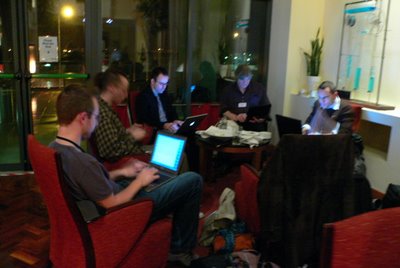
Gavin on the left in the rear, me on the right, everyone else were folks gathered around a powerpoint we all shared...geeks indeed!
So, a busy month!
Got through my patent submission and did some more work on FrankenFilm but it needs more work before it is ready.
Need to get patent work on it finished soon too.
Guess I have to do taxes soon...getting close to deadline time.
That's it for the moment. Been raining cats and dogs here in San Jose, but that's supposed to clear up by mid April. Hope so, I didn't move out here for the rain!
Bill
Came down with a terrible two week cold around the middle of March...just in time for my meeting with IBM.
Found some really interesting consulting to do. It dovetails nicely with the FrankenFilm concept. Can't say much about it yet, but keep an eye on the FrankenFilm site; new developments will most likely show up there.
Had a wonderful time visiting IBM's Alamden Research Center to present thoughts on self adapting content and the future of computing surfaces. I am becoming more and more interested in these ideas I am formng about new computing surfaces...beyond desktops and tablets.
Will be going off to Galway again soon to talk to the folks at DERI. That is a very interesting group and they are exploring some of the most fascinating semantic web ideas out there.
I've included a photo Gavin Mckenzie found of a bunch of us at the Intl Semantic Web Conference we attended last year...otherwise entitled Geeks!
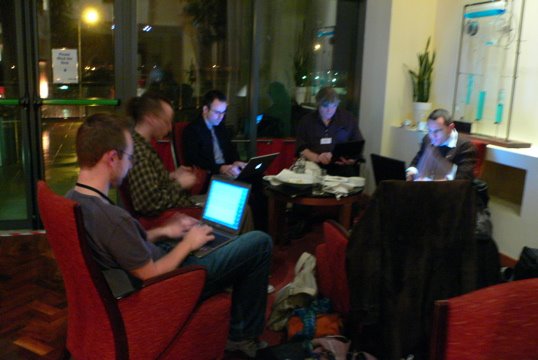
Gavin on the left in the rear, me on the right, everyone else were folks gathered around a powerpoint we all shared...geeks indeed!
So, a busy month!
Got through my patent submission and did some more work on FrankenFilm but it needs more work before it is ready.
Need to get patent work on it finished soon too.
Guess I have to do taxes soon...getting close to deadline time.
That's it for the moment. Been raining cats and dogs here in San Jose, but that's supposed to clear up by mid April. Hope so, I didn't move out here for the rain!
Bill
Monday, March 06, 2006
The Mother Paradox - A Resolution
I haven't seen this explaination before, so I thought I would submit it here.
The Mother or Grandfather paradox is a classic when discussing Time Travel scenarios. Essentially it goes:
If a time traveller goes back in time and kills his mother before he was born then you have a paradox...he wasn't born so he can't have gone back in time to do the killing in which case he was born and did in which case he wasn't and didn't, etc, etc
But the classic statement of the paradox ignores an interpretation of quantum physics, namely Wheeler's Many Worlds Hypothesis.
If the time traveller DOES kill his mother, then he creates a new world, a new universe in which he exists having crossed over from the universe in which he never existed. The paradox is resolved by a simple sideways shuffle. After the killing, he resides in a universe in which he exists, but in which he never did exist.
The beauty of it is that this gets around cosmic censorship while still observing it. No, you cannot have time travel in a manner which creates paradoxes. cosmic censorship sees to that. So you have to move into a universe in which your presence does not create a paradox. With an infinite number of them to choose from, not a problem.
Regards
Bill
The Mother or Grandfather paradox is a classic when discussing Time Travel scenarios. Essentially it goes:
If a time traveller goes back in time and kills his mother before he was born then you have a paradox...he wasn't born so he can't have gone back in time to do the killing in which case he was born and did in which case he wasn't and didn't, etc, etc
But the classic statement of the paradox ignores an interpretation of quantum physics, namely Wheeler's Many Worlds Hypothesis.
If the time traveller DOES kill his mother, then he creates a new world, a new universe in which he exists having crossed over from the universe in which he never existed. The paradox is resolved by a simple sideways shuffle. After the killing, he resides in a universe in which he exists, but in which he never did exist.
The beauty of it is that this gets around cosmic censorship while still observing it. No, you cannot have time travel in a manner which creates paradoxes. cosmic censorship sees to that. So you have to move into a universe in which your presence does not create a paradox. With an infinite number of them to choose from, not a problem.
Regards
Bill
Sunday, March 05, 2006
Intelligent Designers
Isn't it interesting that people, for some obscure psychological reason, continue to ascribe to dieties those powers and abilities rightfully reserved for humans and other intelligent species?
Saturday, February 25, 2006
Discussions on Visualizations
I attended Pat Hanrahan's talk the other day at Adobe. It was on visualization techniques. It was interesting although I found it a little basic. The techniques he described have a long history, dating back to Minard's map of Napoleon's Russian campaign. Phase Space representations and simplified distorted topologies were both shown and discussed. These are certainly valuable visualization techniques, but both have been around for a while.
Phase space representations came of age in 1963 when when Edward Lorenz was plotting weather data and derived the Lorentz Attractor which is a phase space visualization of the data he gathered.
Hanrahan's primary point, however, that the visualization should be chosen to work best with the context in which the data needs to be delivered, is spot on. In many respects, a contextually approrpriate visualization can present data in a manenr that highlights the information content specifically.
This is especially important for self-adapting content. You can extrapolate most of the same principles when the issue of transforming or adapting content to different devices and contexts.
Phase space representations came of age in 1963 when when Edward Lorenz was plotting weather data and derived the Lorentz Attractor which is a phase space visualization of the data he gathered.
Hanrahan's primary point, however, that the visualization should be chosen to work best with the context in which the data needs to be delivered, is spot on. In many respects, a contextually approrpriate visualization can present data in a manenr that highlights the information content specifically.
This is especially important for self-adapting content. You can extrapolate most of the same principles when the issue of transforming or adapting content to different devices and contexts.
Saturday, January 28, 2006
Belief -- Why We Know What We Know
I had a fascinating conversation recently regarding belief. It got me to thinking about the nature of belief and faith and knowledge.
I am very interested in knowledge, what we know, how we know it and how we model it. But knowledge has, for humans, an emotional component. That is, while you know what you know (to an infinite level of recursion by the way) you also have an emotional response to that knowledge we call belief.
Why do I classify belief as an emotional response? Because belief is our emotional response that defends, in a way, our model of the universe. Those things we know very well we come to believe.
Of course belief can be mistaken and it can be changed. We may believe something very strongly, but cease to believe it when presented with strong evidence to the contrary. So, for many years people believed there were only 8 planets in the solar system. Then in 1930 people had to change their belief to accommodate a 9th planet. Many people took quite some time to accommodate this.
We are actually watching a similar belief transition now as people come to terms with the new knowledge that there is a 10th planet beyond Pluto.
But the conversation I was involved in centered around a belief in God. And the person I was in discourse with wanted to know why anyone would not simply choose to believe. He referred to Pascal's Wager which is an argument attributed to Pascal justifying belief in the Christian God on the basis of probability. Essentially, the argument states that one should believe because if one is correct there is an infinite reward to follow whereas if one is wrong there is no harm in having believed during life.
The core problem with this argument, of course, is that we do not CHOOSE to believe. We are drawn to belief, we are coerced to belief by evidence. If I do not find sufficient evidence to believe in a god, I cannot choose to believe in one anyway. In contrast, if I do find sufficient evidence to believe, I cannot choose to NOT believe. Believe is not a choice, it is a coercion.
Tim Holt's website http://www.philosophyofreligion.info/pascalswager.html has a good analysis of the objections to Pascal's Wager of which this is the third.
Belief may be coercive, but it also IS plastic. As evidence accumulates in one direction or another a belief can shift. This is typically, for complex issues and decisions, not a binary switch but rather a continuum that takes the person from a strong belief into the area of doubt, then ultimately to an accolades of the new belief.
But, again, belief is coercive. The accumulation of evidence will ultimately one to a conclusion and a belief even if that is in opposition to previous belief. How many parents honestly believe their child cannot have done THAT (whatever THAT is) only to finally have to acknowledge that the child DID do THAT in the face of more and more incontrovertible evidence.
However, there IS that issue of evidence. While one is coerced to belief by an accumulation of evidence, one's INTERPRETATION of evidence IS a matter of choice. Well, to some degree, anyway. For some things, the evidence is fairly incontrovertible. Or, as Holmes said, "circumstantial evidence my be virtually convincing, as when a trout is found in the milk."
But bigger issues typically have much less clear evidence. So where one person may see evidence of a god in a grain of sand, another may see evidence of complex forces driven by random events. And there is an emotional component to this interpretation as well. We often WANT to believe in particular positions which DOES color our interpretations of evidence even when we try to minimize this.
So where does this leave us? Well, it probably means there is very little chance of people with completely polarized beliefs will be able to convince each other based on current bodies of evidence. And since the interpretation IS colored by other emotionalaspects such as a need or a desire to believe a particular outcome, it is very difficult to move from one point of view to another based solely on improved interpretations. Rather, more and more dramatic evidence is needed. And it is seldom forthcoming.
Comments?
Regards
Bill
I am very interested in knowledge, what we know, how we know it and how we model it. But knowledge has, for humans, an emotional component. That is, while you know what you know (to an infinite level of recursion by the way) you also have an emotional response to that knowledge we call belief.
Why do I classify belief as an emotional response? Because belief is our emotional response that defends, in a way, our model of the universe. Those things we know very well we come to believe.
Of course belief can be mistaken and it can be changed. We may believe something very strongly, but cease to believe it when presented with strong evidence to the contrary. So, for many years people believed there were only 8 planets in the solar system. Then in 1930 people had to change their belief to accommodate a 9th planet. Many people took quite some time to accommodate this.
We are actually watching a similar belief transition now as people come to terms with the new knowledge that there is a 10th planet beyond Pluto.
But the conversation I was involved in centered around a belief in God. And the person I was in discourse with wanted to know why anyone would not simply choose to believe. He referred to Pascal's Wager which is an argument attributed to Pascal justifying belief in the Christian God on the basis of probability. Essentially, the argument states that one should believe because if one is correct there is an infinite reward to follow whereas if one is wrong there is no harm in having believed during life.
The core problem with this argument, of course, is that we do not CHOOSE to believe. We are drawn to belief, we are coerced to belief by evidence. If I do not find sufficient evidence to believe in a god, I cannot choose to believe in one anyway. In contrast, if I do find sufficient evidence to believe, I cannot choose to NOT believe. Believe is not a choice, it is a coercion.
Tim Holt's website http://www.philosophyofreligion.info/pascalswager.html has a good analysis of the objections to Pascal's Wager of which this is the third.
Belief may be coercive, but it also IS plastic. As evidence accumulates in one direction or another a belief can shift. This is typically, for complex issues and decisions, not a binary switch but rather a continuum that takes the person from a strong belief into the area of doubt, then ultimately to an accolades of the new belief.
But, again, belief is coercive. The accumulation of evidence will ultimately one to a conclusion and a belief even if that is in opposition to previous belief. How many parents honestly believe their child cannot have done THAT (whatever THAT is) only to finally have to acknowledge that the child DID do THAT in the face of more and more incontrovertible evidence.
However, there IS that issue of evidence. While one is coerced to belief by an accumulation of evidence, one's INTERPRETATION of evidence IS a matter of choice. Well, to some degree, anyway. For some things, the evidence is fairly incontrovertible. Or, as Holmes said, "circumstantial evidence my be virtually convincing, as when a trout is found in the milk."
But bigger issues typically have much less clear evidence. So where one person may see evidence of a god in a grain of sand, another may see evidence of complex forces driven by random events. And there is an emotional component to this interpretation as well. We often WANT to believe in particular positions which DOES color our interpretations of evidence even when we try to minimize this.
So where does this leave us? Well, it probably means there is very little chance of people with completely polarized beliefs will be able to convince each other based on current bodies of evidence. And since the interpretation IS colored by other emotionalaspects such as a need or a desire to believe a particular outcome, it is very difficult to move from one point of view to another based solely on improved interpretations. Rather, more and more dramatic evidence is needed. And it is seldom forthcoming.
Comments?
Regards
Bill
Sunday, January 22, 2006
Medical Costs of the Future...Lower and Lower
The following is an esay from a book I co-authored in 2000 on the impact of technology on future life (Critial Mass, MC2 Publishers, 2000).
This particular essay is on how I and my writing partner came to feel that medical costs would peak, then fall during the 21st century.
Computers and Medicine: Hippocratic Art becomes Marketing Artifice
People of our generation (so called Baby Boomers) were raised to believe several things about doctors and medicine. First, doctors were members of some sort of priesthood. They knew things we could never know. They had education above and beyond that of normal people. We were encouraged to believe that doctors knew what was best for us and knew things about us we could never know.
Second, medical knowledge was the hidden knowledge of the inner sanctum, the runes of health often cast in terms the average person could not even begin to decipher. Body parts, diseases, conditions, bacteria, and viruses were named in Latin or Greek and often seemed deliberately obtuse. We were not meant to read the prescriptions scrawled by our doctors, or to ask too many questions.
Third, they gave you a sucker if you were a good patient.
The attitude is changing, though. Rising medical costs, coupled with a new understanding of disease and health is changing perceptions about the world of medicine. The cost of medical treatment rises at about 3 to 5 times the rate of inflation. Nothing seems to reduce it. Hospitals have tried to rein in costs. Their ideas, from reducing staff and shortening stays to timesharing equipment among facilities do not keep pace. In desperation, hospitals form conglomerates and try to become managed care associations, which tends to reduce the service to their patients while failing to contain costs. Managed care tries to rein in doctor fees, but the cost in care quality is high. They even stop giving away the suckers.
Finally, they try marketing. It begins to work, but in unforeseen ways.
We have a national (perhaps cultural) taboo against marketing medicine. We don’t like our doctors hawking cures to people so desperate they’ll try anything. We used to see it; we called it Patent Medicine and it earned a well-deserved reputation for deception and danger. When anyone could set up shop on a street corner and sing the praises of assorted elixirs to cure everything from smallpox to social diseases the population was at risk and had no recourse when the so-called cures failed. As a nation, we stepped in and began to regulate medicine and drugs as a way to protect ourselves from the charlatans along the road.
Yet, we have found ways to market prescription medicine and even medical care again. We see commercials about new medicines (carefully avoiding any statement of what they treat) and we see billboards from hospitals regarding the level of obstetric and neo-natal and cardiac care they provide (again, carefully couched to avoid any claims or any discussion of costs). Every sports magazine, women’s magazine and health magazine on the newsstand carries at least a few full page advertisements form prescription medicine, complete with information about uses and side effects that used to be available only to doctors.
We see it because our perception of medicine has changed. The only effective and ethical way to mass-market medicine was to make it more approachable, more understandable. It became necessary to involve patients in their own care to keep costs down. To do that some of the mysticism had to move aside.
Concomitant with the public’s increasing awareness of health and medical issues, computer technology made it possible to consumerize many aspects of medicine. Blood pressure machines began appearing in stores. Electronic thermometers and blood sugar monitors emerged as over the counter devices. Even digital stethoscopes are available to the causal buyer.
While medicine is becoming more approachable and understandable, we still want more. So, what other role does high technology, particularly information technology, play in this move to consumerize medicine?
Start with the hugely expensive MRI and CAT machines. We see amazing images produced by these non-invasive scanners. We can see the Visible Man Project, which available for anyone to see via the Internet, but only possible with computed tomography. Otherwise you would just have thousands of flat photos looking like sliced liver. Because of computed tomography, you can see a three dimensional image that can be rotated in all three axes and zoomed or probed with virtual views. We see TV shows like The Operation with incredibly high tech medical gear. Microsurgery, aided by motion control computers like those used in cinema, allows surgeons to perform absolute miracles.
These devices, while deeply dependent on computer technology, are only the beginning. They are large, complex, and may require a new priesthood of computer-savvy technicians. In addition, they require trained analysts to read the results. What if that were not so?
For centuries, medicine has been viewed as more of an art than a science. Hippocrates’ famous oath, in fact, describes medicine as an art, not a science. The original oath (circa 300 BCE) required young doctors to care for their teachers and teachers’ families and to teach other doctors at no cost. That was probably the first clause to go. It also prohibited surgery (leaving that to the barbers of the time as they had the blades) and abortion. The AMA has changed the original oath just a bit.
Despite the changes in the oath, medicine remains as much art as science. Or, at best, a science in the service of an art.
For example:
Diagnosticians follow complex and intuitive chains of reasoning. Chains they are often at a loss to explain. Arriving at the correct diagnosis in the shortest possible series of steps is still considered one of medicine’s finest skills and students are tested in it constantly. It is obviously important to diagnose the correct problem in the minimum of time since a failure to do so can leave someone very dead. Some doctors have an almost mystical skill at this and they command very high respect in their profession.
Surgeons constantly talk about the delicacy of their operations. “The hands of a surgeon” is a phrase that captures the shamanistic nature of the awe in which surgeons are often held.
And, of course, the old joke goes that you and I, when confronted with a perplexing but solvable problem in our area of expertise, say that, after all, “it’s not rocket science!”
Rocket scientists say, “it’s not brain surgery!”
Brain surgeons say, “actually, it is brain surgery!”
Theirs, it is believed, is the most complicated and delicate of the surgeon’s art. Typical neurosurgeons know this too. They know it all too well. Very big heads in neurosurgery.
Understandable, really. But, perhaps, on the edge of changing.
The advent of the computer has begun a change in this view of medicine. With tremendous amounts of computing power available it is possible to better image the interior of humans and to better simulate the reactions taking place there. Art implies a certain lack of certainty and precision; science implies the opposite. The art of medicine is finally becoming a true science of medicine as our understanding of biochemistry matures. It matures because we can visualize molecules and simulate reactions using computers.
Let us look at a few examples.
Pharmaceutical companies have always referred to their discovery of drugs because of the brute force approach used throughout that industry. The process is changing, however, and now they refer to a drug and its design. Pharmaceutical companies now seek to design molecules, not discover drugs, because we now understand health and disease as macro-level manifestations of molecular processes. To get to this point they have employed information technology at its highest level.
Visualization on computers now allows researchers to see biological processes in simulation. Incredibly complex mathematics used to derive and predict the chemical forces that bind, shape, attract, and repel one organic molecule from another are available as 3D models. Virtual reality with force feedback allows designers to feel those forces as they pick up, twist, bend, and shape chemical compounds into novel and useful forms.
Animal testing moves into the past as our drugs become so tailored to the human condition that the only way to accurately assess their efficacy, other than with human trials, is to simulate their reactions in a human body. Animal models are still great for many purposes, but we can already see the writing on the wall. With the focus now on a genetic basis for disease it will no longer be as useful to test a drug on a rat, a rabbit, or even a chimp. The new class of pharmaceuticals that will emerge in the next few decades will be computer generated and so tailored to humans that animal testing will be useless.
Classic biology has left the realm of the taxonomic and descended to the garage level of the mechanic. Over the last two decades, aided by information technology, biology has begun to finally flourish as a predictive and engineered science. More and more high school biology classes are dissecting frogs virtually rather than using real frogs. Technology created for the film industry to show the subtle changes of a body as it disappears has been re-targeted for use in medical schools to replace the dissection of human cadavers.
Practical medicine is becoming more mechanistic as we unlock the molecular basis of disease, reproduction, and life. As it becomes more mechanistic, it becomes more amenable to being reflected in cyberspace. That is, as our understanding of our physiology drills down toward the lowest molecular nature of life, the information becomes more amenable to digitization. Once digitized, the information that describes the processes that make us ill or make us well can be recognized, manipulated, and administered by computers in far more precise ways than possible today.
Medicine will continue, for a while, to increase in cost. Pharmaceuticals will be costly to develop and the intellectual property represented by them will be hotly protected. But, not for long.
When the computer simulations become accurate enough and when the processes are understood well enough, you will begin to see the movement of medical treatment out of the hospital, outpatient surgery center and doctor’s office to Wal-Mart. You will begin to see computer kiosks that use expert systems to diagnose symptoms described by the customer. Note we said customer, not patient. At this level, you cease being a patient (that has always seemed an interesting term) and become a consumer and customer.
The psychology of taking your medical advice from a machine is considerably different that that of taking such advice from a human practitioner. The writer Larry Niven has referred to autodocs in many of his stories and novels. These are machines you slide into which perform examinations, diagnosis, and finally treatment. Not unlike the booth at the Levi’s shop that measures you for custom made jeans.
We may be a while before we have whole-body autodocs, but you can expect that computerization of medicine will migrate treatment for many ailments into kiosks, into your home and into the mass market. Who needs a pharmacist when a computer can take the prescription and synthesize the molecules needed (the medicine) and dispense directly to you? Who needs a doctor when a computer can take the history, perform the tests, diagnose the ailment, and write the prescription?
Who needs either of them when this can be performed at home? For example, a toilet which will perform many chemical tests on your urine and feces is being developed. The analysis of our eliminations has a long and proud history in medicine (short of surgery, how else could a doctor get anything out of you that had been through the loop, so to speak? Former food was convenient.). Such a toilet will be able to analyze and diagnose a wide variety of conditions. It will recommend treatment, which may be automatically included in your next grocery order since your refrigerator will talk to your toilet.
There is little reason to think that automated treatment is out of the question. Antibiotics could be administered by your bed linens while you sleep or by your clothing the next day. Antibacterial fabric is already a reality. Antibiotic fabric is not too far behind. Nicotine and arthritis patches have made it quite acceptable to have medication dispensed to you through skin absorption.
Our understanding of the effects of particular molecules is increasing steadily. With appropriate analysis of the customer (at the DNA level) and with sufficient computing power it will be possible to have a pharmaceutical synthesizer in your home to catalyze and synthesize molecules tailored to you and your condition. Security is a consideration, but it will be much harder to get an autodoc to dispense unneeded barbiturates or amphetamines than it is to corrupt a human doctor.
A while back Bill had Lasik surgery to improve his eyes. The procedure was painless, quick, and almost completely controlled by computer. It is not too hard to imagine that, in a few years, a machine at a Sears would be available to perform a similar surgery sans ophthalmologist. The necessary computer system to measure, calculate, track and focus a laser to perform such an operation is not beyond imagination at all.
It is not hard to imagine how other forms of simple surgery can be computerized and consumerized. Almost any skin surgery could be done with special lasers and software. Wart, mole, and cyst removal, Melanoma diagnosis, even some liposuction and vein stripping could be made fully safe, cheap, and computerized. Non-invasive surgical techniques will continue to improve with the growing sophistication of computer targeted and focused ultrasound, x-ray, microwave, and other forms of energy.
An elegant solution to bacterial infections is the possibility of using bacteriophages instead of antibiotics. These are viruses which are parasites of bacteria. Specific phages attack specific bacteria. Once the bacteria are dead, the phages die off. The two organisms evolved in twain with each other and bacteria are not likely to develop immunities to phages. They have already adapted as much as necessary. The phage for a particular strain of bacteria is typically found with the bacteria. In the human being, this is usually in the feces.
A computerized toilet could recognize particular disease bacteria, then isolate and amplify the phage associated with that bacteria. The toilet could then insert, inject, or transduce the phage back into the human through injections or patches.
This would form an extremely elegant solution to certain common bacterial infections where today we use broad spectrum antibiotics that prompt many bacteria to form resistant strains. The bacteria die and the phages then die off as well. The intelligent toilet is needed to make it work.
The result is that, in the not too distant future, medicine will become cheap. Sure, we will need controls to make it safe and effective. There will be failures and there will be quackery, but there is a lot of that out there now. We have to move forward to improve medical care, and we can do this if the specialized knowledge of doctors is captured and digitized, the specialized facilities of pharmaceutical companies are miniaturized and digitized, and there is a growing demand for cheaper care.
The driving forces are technological innovation, synthesis miniaturization, and computer control of those processes. The computer control issue is well in hand. Much of the synthesis technology we can take from NASA robot analysis technology on Mars probes. Nanotechnological advances will make chemical factories small and cheap. Research into all of these is in high swing now and we can expect dramatic developments in the future. We can also expect strong resistance.
Pharmaceutical companies are entrenched. Doctors are entrenched. Pharmacists are entrenched. They will all resist as will the public at first. Until the bills roll in.
Where will autodocs catch on first? Probably in third world countries that can’t afford medical care today, much less in the future if the costs keep rising. Provide a village with a device that can accurately diagnose and treat a variety of ailments and injuries for virtually free and third world governments will adopt it with a vengeance. Automated medicine could save millions in developing nations.
Second world nations who are struggling under the effects of brain drains from the cold war will probably adopt it next (they may even be a major part of the development). China, North Korea, and Russia are prime candidates who have or can have the technological skill to develop automated medicine and the lack of skilled practitioners of traditional medicine to prompt a demand.
Ultimately, as our own groaning medical system reaches the limit of its abilities to cope with an aging boomer population (aging into its hundred and twenties because of advances in traditional medicine), we will adopt it here as well. We’ll demand it.
What of the concern that pharmaceutical companies will still be needed to manufacture and distribute the medicines and might still charge inflated prices for them? Pharmaceutical companies rely on intellectual property rights. The molecules they produce and the processes they use to produce them are the secrets they hold dear. But the ability of computer-controlled nanotechnology to manipulate individual atoms into molecular combinations on demand will make those secrets very fleeting.
Once the processes are automated at the atomic or molecular level (rather than the macro reagent level they operate at now) there will be almost nothing to stop any particular drug being taken apart and then re-assembled. Slight, irrelevant changes in the molecule may be the way small firms get around patent issues. Some, in remote seriously ill corners of the globe, will just copy the drug and licenses be damned.
Think of it. Even now, if any village in South Africa (with 10% of its population HIV positive) could synthesize as much AZT as it needed on demand, would patent rights stop them? Not likely.
Sound outrageous? Consider the following:
Cloning of Dolly the sheep (and now many other animals) was accomplished by using delicate but well understood and very replicable techniques. The key turned out to be the application of a minute amount of electricity at just the right point in the process. It is all documented and the equipment and chemicals needed are available and not expensive. Farmers are already looking into it.
DNA strands can now be analyzed by computer circuitry using a special chip that has DNA molecules attached to silicon transistors on the chip. Such a device will soon be used routinely to analyze samples for infections. A home model is already planned.
Scientific American recently published a method by which amateur scientists could invoke the Polymerase Chain Reaction (PCR) in their homes. PCR is a process used in genetic research for rapidly reproducing DNA segments into quantities sufficient for analysis and use. It was invented a few years ago and made DNA research tremendously more effective by reducing the wait times for DNA reactions by factors of thousands. Now, you can do this in your kitchen.
We talk about high-tech medicine in this country all the time, but we’ve seen nothing yet. Most medicine is still the purview of doctors who listen to patients, make an educated guess of the problem, perform a test or two confirm the hypothesis and write a prescription. The “perform a test or two” step is so seriously discouraged by HMO’s and Managed Care insurance (and by National Health in other countries) it is often skipped. None of that is difficult to automate.
When it comes to hospital care, we need to be careful about assuming too much regarding its importance. Most people do not want medical care in hospitals. They tolerate it when nothing else will do. Much hospital care is devoted to easing discomfort in lieu of anything else to be done. People accept that because the discomfort is distracting and depressing.
What people want is medical repair. They want the problem to be corrected and to get on with their lives. Yes, we do want the quick fix. But, if the quick fix actually is a quick fix and the problem actually is corrected, what’s the problem? Influenza used to send millions to their beds and hundreds of thousands to their graves. Now it is a minor annoyance for most in this country.
So, while hospice care for terminal patients will continue in those situations we cannot correct (and there will be many), do not expect people to complain too much about not having hospitals to take care of them when a quick trip to KMart for their cancer cure or to Target for their cardiac repair kit will get them back on track with their life. Automated medicine will offer that.
Medicine and medical care will become very cheap in the future because both are highly amenable to technological innovation and computerization. It is at exactly this intimate level that cyberspace’s digital reflection of our society will be at its sharpest.
This essay is copyright Bill McDaniel and Pat McGrew...used with permission
This particular essay is on how I and my writing partner came to feel that medical costs would peak, then fall during the 21st century.
Computers and Medicine: Hippocratic Art becomes Marketing Artifice
People of our generation (so called Baby Boomers) were raised to believe several things about doctors and medicine. First, doctors were members of some sort of priesthood. They knew things we could never know. They had education above and beyond that of normal people. We were encouraged to believe that doctors knew what was best for us and knew things about us we could never know.
Second, medical knowledge was the hidden knowledge of the inner sanctum, the runes of health often cast in terms the average person could not even begin to decipher. Body parts, diseases, conditions, bacteria, and viruses were named in Latin or Greek and often seemed deliberately obtuse. We were not meant to read the prescriptions scrawled by our doctors, or to ask too many questions.
Third, they gave you a sucker if you were a good patient.
The attitude is changing, though. Rising medical costs, coupled with a new understanding of disease and health is changing perceptions about the world of medicine. The cost of medical treatment rises at about 3 to 5 times the rate of inflation. Nothing seems to reduce it. Hospitals have tried to rein in costs. Their ideas, from reducing staff and shortening stays to timesharing equipment among facilities do not keep pace. In desperation, hospitals form conglomerates and try to become managed care associations, which tends to reduce the service to their patients while failing to contain costs. Managed care tries to rein in doctor fees, but the cost in care quality is high. They even stop giving away the suckers.
Finally, they try marketing. It begins to work, but in unforeseen ways.
We have a national (perhaps cultural) taboo against marketing medicine. We don’t like our doctors hawking cures to people so desperate they’ll try anything. We used to see it; we called it Patent Medicine and it earned a well-deserved reputation for deception and danger. When anyone could set up shop on a street corner and sing the praises of assorted elixirs to cure everything from smallpox to social diseases the population was at risk and had no recourse when the so-called cures failed. As a nation, we stepped in and began to regulate medicine and drugs as a way to protect ourselves from the charlatans along the road.
Yet, we have found ways to market prescription medicine and even medical care again. We see commercials about new medicines (carefully avoiding any statement of what they treat) and we see billboards from hospitals regarding the level of obstetric and neo-natal and cardiac care they provide (again, carefully couched to avoid any claims or any discussion of costs). Every sports magazine, women’s magazine and health magazine on the newsstand carries at least a few full page advertisements form prescription medicine, complete with information about uses and side effects that used to be available only to doctors.
We see it because our perception of medicine has changed. The only effective and ethical way to mass-market medicine was to make it more approachable, more understandable. It became necessary to involve patients in their own care to keep costs down. To do that some of the mysticism had to move aside.
Concomitant with the public’s increasing awareness of health and medical issues, computer technology made it possible to consumerize many aspects of medicine. Blood pressure machines began appearing in stores. Electronic thermometers and blood sugar monitors emerged as over the counter devices. Even digital stethoscopes are available to the causal buyer.
While medicine is becoming more approachable and understandable, we still want more. So, what other role does high technology, particularly information technology, play in this move to consumerize medicine?
Start with the hugely expensive MRI and CAT machines. We see amazing images produced by these non-invasive scanners. We can see the Visible Man Project, which available for anyone to see via the Internet, but only possible with computed tomography. Otherwise you would just have thousands of flat photos looking like sliced liver. Because of computed tomography, you can see a three dimensional image that can be rotated in all three axes and zoomed or probed with virtual views. We see TV shows like The Operation with incredibly high tech medical gear. Microsurgery, aided by motion control computers like those used in cinema, allows surgeons to perform absolute miracles.
These devices, while deeply dependent on computer technology, are only the beginning. They are large, complex, and may require a new priesthood of computer-savvy technicians. In addition, they require trained analysts to read the results. What if that were not so?
For centuries, medicine has been viewed as more of an art than a science. Hippocrates’ famous oath, in fact, describes medicine as an art, not a science. The original oath (circa 300 BCE) required young doctors to care for their teachers and teachers’ families and to teach other doctors at no cost. That was probably the first clause to go. It also prohibited surgery (leaving that to the barbers of the time as they had the blades) and abortion. The AMA has changed the original oath just a bit.
Despite the changes in the oath, medicine remains as much art as science. Or, at best, a science in the service of an art.
For example:
Diagnosticians follow complex and intuitive chains of reasoning. Chains they are often at a loss to explain. Arriving at the correct diagnosis in the shortest possible series of steps is still considered one of medicine’s finest skills and students are tested in it constantly. It is obviously important to diagnose the correct problem in the minimum of time since a failure to do so can leave someone very dead. Some doctors have an almost mystical skill at this and they command very high respect in their profession.
Surgeons constantly talk about the delicacy of their operations. “The hands of a surgeon” is a phrase that captures the shamanistic nature of the awe in which surgeons are often held.
And, of course, the old joke goes that you and I, when confronted with a perplexing but solvable problem in our area of expertise, say that, after all, “it’s not rocket science!”
Rocket scientists say, “it’s not brain surgery!”
Brain surgeons say, “actually, it is brain surgery!”
Theirs, it is believed, is the most complicated and delicate of the surgeon’s art. Typical neurosurgeons know this too. They know it all too well. Very big heads in neurosurgery.
Understandable, really. But, perhaps, on the edge of changing.
The advent of the computer has begun a change in this view of medicine. With tremendous amounts of computing power available it is possible to better image the interior of humans and to better simulate the reactions taking place there. Art implies a certain lack of certainty and precision; science implies the opposite. The art of medicine is finally becoming a true science of medicine as our understanding of biochemistry matures. It matures because we can visualize molecules and simulate reactions using computers.
Let us look at a few examples.
Pharmaceutical companies have always referred to their discovery of drugs because of the brute force approach used throughout that industry. The process is changing, however, and now they refer to a drug and its design. Pharmaceutical companies now seek to design molecules, not discover drugs, because we now understand health and disease as macro-level manifestations of molecular processes. To get to this point they have employed information technology at its highest level.
Visualization on computers now allows researchers to see biological processes in simulation. Incredibly complex mathematics used to derive and predict the chemical forces that bind, shape, attract, and repel one organic molecule from another are available as 3D models. Virtual reality with force feedback allows designers to feel those forces as they pick up, twist, bend, and shape chemical compounds into novel and useful forms.
Animal testing moves into the past as our drugs become so tailored to the human condition that the only way to accurately assess their efficacy, other than with human trials, is to simulate their reactions in a human body. Animal models are still great for many purposes, but we can already see the writing on the wall. With the focus now on a genetic basis for disease it will no longer be as useful to test a drug on a rat, a rabbit, or even a chimp. The new class of pharmaceuticals that will emerge in the next few decades will be computer generated and so tailored to humans that animal testing will be useless.
Classic biology has left the realm of the taxonomic and descended to the garage level of the mechanic. Over the last two decades, aided by information technology, biology has begun to finally flourish as a predictive and engineered science. More and more high school biology classes are dissecting frogs virtually rather than using real frogs. Technology created for the film industry to show the subtle changes of a body as it disappears has been re-targeted for use in medical schools to replace the dissection of human cadavers.
Practical medicine is becoming more mechanistic as we unlock the molecular basis of disease, reproduction, and life. As it becomes more mechanistic, it becomes more amenable to being reflected in cyberspace. That is, as our understanding of our physiology drills down toward the lowest molecular nature of life, the information becomes more amenable to digitization. Once digitized, the information that describes the processes that make us ill or make us well can be recognized, manipulated, and administered by computers in far more precise ways than possible today.
Medicine will continue, for a while, to increase in cost. Pharmaceuticals will be costly to develop and the intellectual property represented by them will be hotly protected. But, not for long.
When the computer simulations become accurate enough and when the processes are understood well enough, you will begin to see the movement of medical treatment out of the hospital, outpatient surgery center and doctor’s office to Wal-Mart. You will begin to see computer kiosks that use expert systems to diagnose symptoms described by the customer. Note we said customer, not patient. At this level, you cease being a patient (that has always seemed an interesting term) and become a consumer and customer.
The psychology of taking your medical advice from a machine is considerably different that that of taking such advice from a human practitioner. The writer Larry Niven has referred to autodocs in many of his stories and novels. These are machines you slide into which perform examinations, diagnosis, and finally treatment. Not unlike the booth at the Levi’s shop that measures you for custom made jeans.
We may be a while before we have whole-body autodocs, but you can expect that computerization of medicine will migrate treatment for many ailments into kiosks, into your home and into the mass market. Who needs a pharmacist when a computer can take the prescription and synthesize the molecules needed (the medicine) and dispense directly to you? Who needs a doctor when a computer can take the history, perform the tests, diagnose the ailment, and write the prescription?
Who needs either of them when this can be performed at home? For example, a toilet which will perform many chemical tests on your urine and feces is being developed. The analysis of our eliminations has a long and proud history in medicine (short of surgery, how else could a doctor get anything out of you that had been through the loop, so to speak? Former food was convenient.). Such a toilet will be able to analyze and diagnose a wide variety of conditions. It will recommend treatment, which may be automatically included in your next grocery order since your refrigerator will talk to your toilet.
There is little reason to think that automated treatment is out of the question. Antibiotics could be administered by your bed linens while you sleep or by your clothing the next day. Antibacterial fabric is already a reality. Antibiotic fabric is not too far behind. Nicotine and arthritis patches have made it quite acceptable to have medication dispensed to you through skin absorption.
Our understanding of the effects of particular molecules is increasing steadily. With appropriate analysis of the customer (at the DNA level) and with sufficient computing power it will be possible to have a pharmaceutical synthesizer in your home to catalyze and synthesize molecules tailored to you and your condition. Security is a consideration, but it will be much harder to get an autodoc to dispense unneeded barbiturates or amphetamines than it is to corrupt a human doctor.
A while back Bill had Lasik surgery to improve his eyes. The procedure was painless, quick, and almost completely controlled by computer. It is not too hard to imagine that, in a few years, a machine at a Sears would be available to perform a similar surgery sans ophthalmologist. The necessary computer system to measure, calculate, track and focus a laser to perform such an operation is not beyond imagination at all.
It is not hard to imagine how other forms of simple surgery can be computerized and consumerized. Almost any skin surgery could be done with special lasers and software. Wart, mole, and cyst removal, Melanoma diagnosis, even some liposuction and vein stripping could be made fully safe, cheap, and computerized. Non-invasive surgical techniques will continue to improve with the growing sophistication of computer targeted and focused ultrasound, x-ray, microwave, and other forms of energy.
An elegant solution to bacterial infections is the possibility of using bacteriophages instead of antibiotics. These are viruses which are parasites of bacteria. Specific phages attack specific bacteria. Once the bacteria are dead, the phages die off. The two organisms evolved in twain with each other and bacteria are not likely to develop immunities to phages. They have already adapted as much as necessary. The phage for a particular strain of bacteria is typically found with the bacteria. In the human being, this is usually in the feces.
A computerized toilet could recognize particular disease bacteria, then isolate and amplify the phage associated with that bacteria. The toilet could then insert, inject, or transduce the phage back into the human through injections or patches.
This would form an extremely elegant solution to certain common bacterial infections where today we use broad spectrum antibiotics that prompt many bacteria to form resistant strains. The bacteria die and the phages then die off as well. The intelligent toilet is needed to make it work.
The result is that, in the not too distant future, medicine will become cheap. Sure, we will need controls to make it safe and effective. There will be failures and there will be quackery, but there is a lot of that out there now. We have to move forward to improve medical care, and we can do this if the specialized knowledge of doctors is captured and digitized, the specialized facilities of pharmaceutical companies are miniaturized and digitized, and there is a growing demand for cheaper care.
The driving forces are technological innovation, synthesis miniaturization, and computer control of those processes. The computer control issue is well in hand. Much of the synthesis technology we can take from NASA robot analysis technology on Mars probes. Nanotechnological advances will make chemical factories small and cheap. Research into all of these is in high swing now and we can expect dramatic developments in the future. We can also expect strong resistance.
Pharmaceutical companies are entrenched. Doctors are entrenched. Pharmacists are entrenched. They will all resist as will the public at first. Until the bills roll in.
Where will autodocs catch on first? Probably in third world countries that can’t afford medical care today, much less in the future if the costs keep rising. Provide a village with a device that can accurately diagnose and treat a variety of ailments and injuries for virtually free and third world governments will adopt it with a vengeance. Automated medicine could save millions in developing nations.
Second world nations who are struggling under the effects of brain drains from the cold war will probably adopt it next (they may even be a major part of the development). China, North Korea, and Russia are prime candidates who have or can have the technological skill to develop automated medicine and the lack of skilled practitioners of traditional medicine to prompt a demand.
Ultimately, as our own groaning medical system reaches the limit of its abilities to cope with an aging boomer population (aging into its hundred and twenties because of advances in traditional medicine), we will adopt it here as well. We’ll demand it.
What of the concern that pharmaceutical companies will still be needed to manufacture and distribute the medicines and might still charge inflated prices for them? Pharmaceutical companies rely on intellectual property rights. The molecules they produce and the processes they use to produce them are the secrets they hold dear. But the ability of computer-controlled nanotechnology to manipulate individual atoms into molecular combinations on demand will make those secrets very fleeting.
Once the processes are automated at the atomic or molecular level (rather than the macro reagent level they operate at now) there will be almost nothing to stop any particular drug being taken apart and then re-assembled. Slight, irrelevant changes in the molecule may be the way small firms get around patent issues. Some, in remote seriously ill corners of the globe, will just copy the drug and licenses be damned.
Think of it. Even now, if any village in South Africa (with 10% of its population HIV positive) could synthesize as much AZT as it needed on demand, would patent rights stop them? Not likely.
Sound outrageous? Consider the following:
Cloning of Dolly the sheep (and now many other animals) was accomplished by using delicate but well understood and very replicable techniques. The key turned out to be the application of a minute amount of electricity at just the right point in the process. It is all documented and the equipment and chemicals needed are available and not expensive. Farmers are already looking into it.
DNA strands can now be analyzed by computer circuitry using a special chip that has DNA molecules attached to silicon transistors on the chip. Such a device will soon be used routinely to analyze samples for infections. A home model is already planned.
Scientific American recently published a method by which amateur scientists could invoke the Polymerase Chain Reaction (PCR) in their homes. PCR is a process used in genetic research for rapidly reproducing DNA segments into quantities sufficient for analysis and use. It was invented a few years ago and made DNA research tremendously more effective by reducing the wait times for DNA reactions by factors of thousands. Now, you can do this in your kitchen.
We talk about high-tech medicine in this country all the time, but we’ve seen nothing yet. Most medicine is still the purview of doctors who listen to patients, make an educated guess of the problem, perform a test or two confirm the hypothesis and write a prescription. The “perform a test or two” step is so seriously discouraged by HMO’s and Managed Care insurance (and by National Health in other countries) it is often skipped. None of that is difficult to automate.
When it comes to hospital care, we need to be careful about assuming too much regarding its importance. Most people do not want medical care in hospitals. They tolerate it when nothing else will do. Much hospital care is devoted to easing discomfort in lieu of anything else to be done. People accept that because the discomfort is distracting and depressing.
What people want is medical repair. They want the problem to be corrected and to get on with their lives. Yes, we do want the quick fix. But, if the quick fix actually is a quick fix and the problem actually is corrected, what’s the problem? Influenza used to send millions to their beds and hundreds of thousands to their graves. Now it is a minor annoyance for most in this country.
So, while hospice care for terminal patients will continue in those situations we cannot correct (and there will be many), do not expect people to complain too much about not having hospitals to take care of them when a quick trip to KMart for their cancer cure or to Target for their cardiac repair kit will get them back on track with their life. Automated medicine will offer that.
Medicine and medical care will become very cheap in the future because both are highly amenable to technological innovation and computerization. It is at exactly this intimate level that cyberspace’s digital reflection of our society will be at its sharpest.
This essay is copyright Bill McDaniel and Pat McGrew...used with permission
Thursday, January 19, 2006
Pattern Recognition - A New Approach
Pattern recognition is re-emerging as one of the most important aspects of Artificial Intelligence and Neurological research. What has recently been determined is that a significant portion of neurological processing is actually pattern matching. Even what we think of as deductive reasoning is begining to be seen as a process involving a tremendous amount of pattern matching in its initial phase.
This re-raises the question of learnign machine algorithms and computational structures such as neural nets. Currently Neural nets have been getting a bad rap...Everyone seems to think that Support Vector Machines, AdaBoost, and other more recently derived algorithms.
However, the simplicity of construction coupled with the complexity of ability that classic neural nets provide strikes me as a powerful place to step off from in search of computational models of effective neurological processes. Or, as I have said before, I do not solve differential equations when I catch a ball (nor even quadratic equations).
Classic neural nets learn to recognize and segregate patterns through altered strengths of the connections between simplistic computing elements (neurons that pefome a simple sigmoid transfer or a discrete threshold transform).
But while neural net based pattern matching relies on strengthenng and weakening connection potentials between these artificial neurons, there are other emergent effects which are not fed back into the pattern matching process.
Essentially, what I am proposing here is that, as in continuous equations, patterns of data have multiple derivatives, slopes if you will, that reflect overlying patterns which moreadvanced techniques can take into account.
Neural nets do this to some degree as it is, but multi-layer nets do it better at the pure data level. The hidden layer of modern neural nets effectively captures the first derivative of the data pattern in an ordered set of connection weights. The connections encode the rate of change of the incoming feature data for different inputs, with differnt variations in those rates of change encoding different pattersn.
Please note, this is all sort of metaphorical. Discussing an encoding of data patterns as derivatives or trates of channge is not precisely accurate. However, Fourier transforms of image data do a similar reduction of a collection of data treated as a distribution of frequencies.
If we carry the analogy a step further, then, we could talk about the second derivative of the data pattern which would be the first derivative of the neural net's resulting pattern. From THAT pattern we could begin to derive deeper recognition of internal structures to our original data.
So, if we had one neural net stacked above another (metaphorically speaking) we could have it watch for pattersn in the lower level net. These patterns woudl arise from the patterns it detected in the data. Allowing the second level net to classify states in the first net provides a deeper, more refined set of nuances to the classification.
My recent experiments with this idea show a great deal of promise. However, the key remains to identify specific features of the first net to pass on to the second. The math associated with this effort is still somewhat obscure.
But the idea of stacked netswatching each other's patterns is similar to the way our brains networks watch each other. By feeding back patterns of connections and classifications about the primary networks, the secondary (and perhaps tertiary) networks can provide non-linear effects that act as perturbing noise in the process of pattern recognition.
Note that I am not talking about extra hidden layers in a network. It has been largely shown that extra hidden layers beyond about 2 do not add any benefit to the processing of the net. I suspect this is actually because we do not construct the nets with sufficient complexity.
However, I am talking about discontiguous nets, one being driven by extracted features from the other which is being driven by extracted features from a document or text corpora. The benefits from recognizing deeper patterns would provide us with nuanced patterns such as a recognition of trend data and sublties within the structure of the original data.
Thsi is a bit different from the other use f the term stacked neural nets that is common. In that use the same dayta (text for example) is passed to multipe nets that are trained to seek specific types of first level patterns. While the nets feed some information to the next net to recieve the data, they are essentially parallel and are all generating this first dericvative I spoke of. In my model, the higher order network is completely unaware of the the actual original text or data coming to it. Rather it is examining patterns of neuronal connections that it sees in the lowel level net without any knowledge of how they came to be.
Comments?
Bill
This re-raises the question of learnign machine algorithms and computational structures such as neural nets. Currently Neural nets have been getting a bad rap...Everyone seems to think that Support Vector Machines, AdaBoost, and other more recently derived algorithms.
However, the simplicity of construction coupled with the complexity of ability that classic neural nets provide strikes me as a powerful place to step off from in search of computational models of effective neurological processes. Or, as I have said before, I do not solve differential equations when I catch a ball (nor even quadratic equations).
Classic neural nets learn to recognize and segregate patterns through altered strengths of the connections between simplistic computing elements (neurons that pefome a simple sigmoid transfer or a discrete threshold transform).
But while neural net based pattern matching relies on strengthenng and weakening connection potentials between these artificial neurons, there are other emergent effects which are not fed back into the pattern matching process.
Essentially, what I am proposing here is that, as in continuous equations, patterns of data have multiple derivatives, slopes if you will, that reflect overlying patterns which moreadvanced techniques can take into account.
Neural nets do this to some degree as it is, but multi-layer nets do it better at the pure data level. The hidden layer of modern neural nets effectively captures the first derivative of the data pattern in an ordered set of connection weights. The connections encode the rate of change of the incoming feature data for different inputs, with differnt variations in those rates of change encoding different pattersn.
Please note, this is all sort of metaphorical. Discussing an encoding of data patterns as derivatives or trates of channge is not precisely accurate. However, Fourier transforms of image data do a similar reduction of a collection of data treated as a distribution of frequencies.
If we carry the analogy a step further, then, we could talk about the second derivative of the data pattern which would be the first derivative of the neural net's resulting pattern. From THAT pattern we could begin to derive deeper recognition of internal structures to our original data.
So, if we had one neural net stacked above another (metaphorically speaking) we could have it watch for pattersn in the lower level net. These patterns woudl arise from the patterns it detected in the data. Allowing the second level net to classify states in the first net provides a deeper, more refined set of nuances to the classification.
My recent experiments with this idea show a great deal of promise. However, the key remains to identify specific features of the first net to pass on to the second. The math associated with this effort is still somewhat obscure.
But the idea of stacked netswatching each other's patterns is similar to the way our brains networks watch each other. By feeding back patterns of connections and classifications about the primary networks, the secondary (and perhaps tertiary) networks can provide non-linear effects that act as perturbing noise in the process of pattern recognition.
Note that I am not talking about extra hidden layers in a network. It has been largely shown that extra hidden layers beyond about 2 do not add any benefit to the processing of the net. I suspect this is actually because we do not construct the nets with sufficient complexity.
However, I am talking about discontiguous nets, one being driven by extracted features from the other which is being driven by extracted features from a document or text corpora. The benefits from recognizing deeper patterns would provide us with nuanced patterns such as a recognition of trend data and sublties within the structure of the original data.
Thsi is a bit different from the other use f the term stacked neural nets that is common. In that use the same dayta (text for example) is passed to multipe nets that are trained to seek specific types of first level patterns. While the nets feed some information to the next net to recieve the data, they are essentially parallel and are all generating this first dericvative I spoke of. In my model, the higher order network is completely unaware of the the actual original text or data coming to it. Rather it is examining patterns of neuronal connections that it sees in the lowel level net without any knowledge of how they came to be.
Comments?
Bill
Monday, January 16, 2006
A Rant -- When Things are Too Hard
This is a rant
And, I hate to say it, but it is a rant about how things are done here in the bay area.
In particular, it is a rant about shopping for food
WHAT is it about grocery stores here in San Jose?
The shelves are NEVER stocked well. They are not fronted. My WIFE had to get on the floor and reach deep into the back of the shelves to find peanut butter, corn, pork and beans, and many other canned goods.
Thsi is not just about the Safeway on San Carlos where we shopped today...Albertson's, Zanotto's, even Trader Joe's looks like this a lot.
It wasn't just today...although a mnaager told me that a bunch of people just did not show up to work last night to stock and front shelves. But I have seen all these store look like this many times over the two years I have lived here.
I mentioned that I saw a lot of people wandering around...why couldn't some of them be facing shelves, making shopping more convenient for consumers? He just said they were busy with other things.
I suggested to him that, since I had been approached by two people asking for money for a school just at the front door, he should perhaps pay them to face the shelves. He explained that he couldn't just have "day laborers" do it. Then he walked away.
Well, perhaps he couldn't. Perhaps it really is more complicated than that to keep shelves stocked and faced. Perhaps it is just too hard a job for this manager to make shopping easy and convenient for the customers.
As someone from another place let me make a definitive statement. The customer service in this town sucks! Stores are poorly stocked, have few varieties and are absolutely not interested in making shopping better for the consumer.
Infrastructure is terrible...carts that wobble, tile floors that are cracked, shelf tags that are missing, goods that are mislabelled. From a retail standpoint, this town needs an enema!
I don't understand it. Why is it acceptable here to have poor shopping, poor selection, poor equipment, and poor infrastructure to get things done. The staff are friendly enough. They seem willing to help, but the management and owners, the rule setters and decision makers act as if customers are their last concerns.
I am not just speaking of food store either...clothing stores, music stores, hardware stores, furniture stores, restaurants...all seem to consider customers an interruption and a problem
Well, enough of that. Managers, Store Owners and Operators, clean up your acts and clean up your stores. Stop making excuses and serve your customers.
Bill
And, I hate to say it, but it is a rant about how things are done here in the bay area.
In particular, it is a rant about shopping for food
WHAT is it about grocery stores here in San Jose?
The shelves are NEVER stocked well. They are not fronted. My WIFE had to get on the floor and reach deep into the back of the shelves to find peanut butter, corn, pork and beans, and many other canned goods.
Thsi is not just about the Safeway on San Carlos where we shopped today...Albertson's, Zanotto's, even Trader Joe's looks like this a lot.
It wasn't just today...although a mnaager told me that a bunch of people just did not show up to work last night to stock and front shelves. But I have seen all these store look like this many times over the two years I have lived here.
I mentioned that I saw a lot of people wandering around...why couldn't some of them be facing shelves, making shopping more convenient for consumers? He just said they were busy with other things.
I suggested to him that, since I had been approached by two people asking for money for a school just at the front door, he should perhaps pay them to face the shelves. He explained that he couldn't just have "day laborers" do it. Then he walked away.
Well, perhaps he couldn't. Perhaps it really is more complicated than that to keep shelves stocked and faced. Perhaps it is just too hard a job for this manager to make shopping easy and convenient for the customers.
As someone from another place let me make a definitive statement. The customer service in this town sucks! Stores are poorly stocked, have few varieties and are absolutely not interested in making shopping better for the consumer.
Infrastructure is terrible...carts that wobble, tile floors that are cracked, shelf tags that are missing, goods that are mislabelled. From a retail standpoint, this town needs an enema!
I don't understand it. Why is it acceptable here to have poor shopping, poor selection, poor equipment, and poor infrastructure to get things done. The staff are friendly enough. They seem willing to help, but the management and owners, the rule setters and decision makers act as if customers are their last concerns.
I am not just speaking of food store either...clothing stores, music stores, hardware stores, furniture stores, restaurants...all seem to consider customers an interruption and a problem
Well, enough of that. Managers, Store Owners and Operators, clean up your acts and clean up your stores. Stop making excuses and serve your customers.
Bill
Friday, January 13, 2006
Churchill Club Visit and Tech trends
I joined the Churchill Club here recently and attended my first meeting last night which was the top tech trends for 2006. This was an interesting panel discussion/debate (not formal) with some audience voting on agreement with the panelists.
I was struck by two specific things
1) Each panel member (VC's of course) had specific vertical interests they wanted to mention. That makes sense, of course. The other panelists would agree or disagree, but everyone had a specific area of technological interest.
2) They did not actually integrate well. At one point Panelist A says X will happen. Panelist B says Y will happen, but A disagrees...Even though Y's occurrence is what will make X possible. Even when they
There was a lot of talk about new bio science trends as the place to make tech plays. There was also discussion about the overall plateauing of software and computing as an industry.
There was quite a lot of discussion and surprise at the idea that leaders in the computing field should recently have become interested in the biotech field.
None of them seemed to get that the next big COMPUTING revolution will be in BIOLOGICAL computation...The leveraging of the new, mechanistic understanding of biological processes at the molecular level to provide a surge in technological innovation in the computing arena.
While the presentation was very interesting, I sensed that the panel and even many of the attendees still didn't get it. The truly amazing thing that is beginning to happen in this century is NOT the advent of whole new technologies like genomics and proteomics, or the incredible advances in speed, performance, and miniaturization of electronics.
The thing to watch is the collapse of barriers between what have been disparate disciplines. Information Theory, as applied to Biological Engineering which feeds back into Materials Science to drive new Information technologies which will expand the biological horizons etc, etc, etc.
The synthesis of all these disparate fields...Biology, materials, electronics, photonics, chemistry, and radiology ... The synthesis of these is where ethe next huge leap in our technological civilization will be coming from.
Watch this space! You think things are strange now with kids getting pierced and tatooed, clothes that are starting to phone home for cleaning instructions, and locale-based technologies allowing the tracking of goods, people, and information?
Wait until the tatoos are wirelessly linked to the net to provide virtual services such as data and voice communication via clothes that reshape themselves based on the contextual environment of the wearer.
It gets weird from here!
And the VC's and Technologists of the world need to look at the synthesis, not the thesis.
My joining the Churchill Club was a good idea though and I intend to take in many of their meetings ... But I urge companies, economists, predictors and VCs trying to find the next big trend to look further out in a sense. The speed of change is about to be so great that 'further out' will be only 36-48 months in time, as it has been for these folks for decades. However, the AMOUNT of change in that time period will be far greater than ever before.
So a good idea today will be an expired idea in 6 months...Having already made its mark and brought in its revenue. To get ahead of THAT curve, people need to look at the emergent consequences of the exponentially increasing rate of change and figure out how what appear to be diverse technological trends will converge into products, services, and business models in a very sort time.
Comments?
Bill
I was struck by two specific things
1) Each panel member (VC's of course) had specific vertical interests they wanted to mention. That makes sense, of course. The other panelists would agree or disagree, but everyone had a specific area of technological interest.
2) They did not actually integrate well. At one point Panelist A says X will happen. Panelist B says Y will happen, but A disagrees...Even though Y's occurrence is what will make X possible. Even when they
There was a lot of talk about new bio science trends as the place to make tech plays. There was also discussion about the overall plateauing of software and computing as an industry.
There was quite a lot of discussion and surprise at the idea that leaders in the computing field should recently have become interested in the biotech field.
None of them seemed to get that the next big COMPUTING revolution will be in BIOLOGICAL computation...The leveraging of the new, mechanistic understanding of biological processes at the molecular level to provide a surge in technological innovation in the computing arena.
While the presentation was very interesting, I sensed that the panel and even many of the attendees still didn't get it. The truly amazing thing that is beginning to happen in this century is NOT the advent of whole new technologies like genomics and proteomics, or the incredible advances in speed, performance, and miniaturization of electronics.
The thing to watch is the collapse of barriers between what have been disparate disciplines. Information Theory, as applied to Biological Engineering which feeds back into Materials Science to drive new Information technologies which will expand the biological horizons etc, etc, etc.
The synthesis of all these disparate fields...Biology, materials, electronics, photonics, chemistry, and radiology ... The synthesis of these is where ethe next huge leap in our technological civilization will be coming from.
Watch this space! You think things are strange now with kids getting pierced and tatooed, clothes that are starting to phone home for cleaning instructions, and locale-based technologies allowing the tracking of goods, people, and information?
Wait until the tatoos are wirelessly linked to the net to provide virtual services such as data and voice communication via clothes that reshape themselves based on the contextual environment of the wearer.
It gets weird from here!
And the VC's and Technologists of the world need to look at the synthesis, not the thesis.
My joining the Churchill Club was a good idea though and I intend to take in many of their meetings ... But I urge companies, economists, predictors and VCs trying to find the next big trend to look further out in a sense. The speed of change is about to be so great that 'further out' will be only 36-48 months in time, as it has been for these folks for decades. However, the AMOUNT of change in that time period will be far greater than ever before.
So a good idea today will be an expired idea in 6 months...Having already made its mark and brought in its revenue. To get ahead of THAT curve, people need to look at the emergent consequences of the exponentially increasing rate of change and figure out how what appear to be diverse technological trends will converge into products, services, and business models in a very sort time.
Comments?
Bill
Monday, January 09, 2006
Singularities and Growth Curves
I am in the middle of reading Ray Kurzweil's The Singularity is Near. This book inspired the previous one I mentioned, Accelreando, it is fairly obvious.
The recognition of accererating reurns is certainly the most important concept in the book. As far back as 1996 I began talking in my presentations to electronic document professionals, about how change was coming quickly, but the second derivative, the acceleation of that change was far more important than the speed of change itself. It is a hard concept for people to understand.
Change always seems to be coming too quickly. The very idea that it may be coming ever MORE quickly is frightening to many. Hwever, Kurzweil does an excellent job of explaining how accelerating returns really means that change and evolutionary shift IS occurring at ever increasing paces.
The conclusion he draws, about people merging with their technology to produce a new evolutionary step in the track of humanity is debatable. It is extremely difficult for most to concieve of such radical changes while still having the result be 'human'.
His arguments, however, are very cogent. The nature of humanity is certainly not tied up in our limbs, our physical form, or even our ways of interacting with the world. Is this not precisel what most major religions are teaching? That these physical forms do not matter? In many respects I see the same concepts in Singularity but driven by human mediated forces, not supernatural ones.
That makes a great deal of sense to me. We have, as a species, always attempted to transcend ourselves as they are now. suddenly, Singularity is saying, we are going to be able to do that in ways that will be so self evident as to be undeniable. Which leave me with a thought.
here is a debate going on between Evolutionists and Intelligent Design supporters. The gist of ID's arguemnt is that life as we know it, particularly human life, is so complex it MUST have been designed. It could not have emerged through even billions of years of random change and evolutionary pressure.
I do not agree...I see evolution working all the time and I believe it has sufficiently strong scientific evidence to be completely convincing as the driving architect of what we see.
BUT, if Kurzweil is correct, then perhaps the NEXT thing we see is comlex, human, intelligent life that IS designed by an intelligence...US!
The ID folks may just have the characters in their pasion play mixed up!
Scary
Bill
The recognition of accererating reurns is certainly the most important concept in the book. As far back as 1996 I began talking in my presentations to electronic document professionals, about how change was coming quickly, but the second derivative, the acceleation of that change was far more important than the speed of change itself. It is a hard concept for people to understand.
Change always seems to be coming too quickly. The very idea that it may be coming ever MORE quickly is frightening to many. Hwever, Kurzweil does an excellent job of explaining how accelerating returns really means that change and evolutionary shift IS occurring at ever increasing paces.
The conclusion he draws, about people merging with their technology to produce a new evolutionary step in the track of humanity is debatable. It is extremely difficult for most to concieve of such radical changes while still having the result be 'human'.
His arguments, however, are very cogent. The nature of humanity is certainly not tied up in our limbs, our physical form, or even our ways of interacting with the world. Is this not precisel what most major religions are teaching? That these physical forms do not matter? In many respects I see the same concepts in Singularity but driven by human mediated forces, not supernatural ones.
That makes a great deal of sense to me. We have, as a species, always attempted to transcend ourselves as they are now. suddenly, Singularity is saying, we are going to be able to do that in ways that will be so self evident as to be undeniable. Which leave me with a thought.
here is a debate going on between Evolutionists and Intelligent Design supporters. The gist of ID's arguemnt is that life as we know it, particularly human life, is so complex it MUST have been designed. It could not have emerged through even billions of years of random change and evolutionary pressure.
I do not agree...I see evolution working all the time and I believe it has sufficiently strong scientific evidence to be completely convincing as the driving architect of what we see.
BUT, if Kurzweil is correct, then perhaps the NEXT thing we see is comlex, human, intelligent life that IS designed by an intelligence...US!
The ID folks may just have the characters in their pasion play mixed up!
Scary
Bill
Friday, December 30, 2005
A New Theory of Surfaces?
I have been thinking about my ideas for a new theory of surfaces in interior design and I believe I can at last make some comments that are reasonably cogent.
To begin, we should define terms. By Theory of Surfaces I do not refer to the mathematical study of 2 manifolds, but rather to the study of how people use surfaces in a building and what they need from those surfaces. A new theory will deal not just with the aesthetics and the orientation of those surfaces (from horizontal to fully vertical) but with their utility in the light of the 21st century and the way our use of space and surface is changing.
To explore that a little bit, let's consider the future needs for a horizontal surface such as an end table or coffee table. Assuming people will be placing items on the tables including remote controls and computer monitors or keyboards. The fact that these types of devices will be placed on a table changes the requirements for the surface. for example, the coefficient of friction of the tabletop needs to be tuned to allow for smooth operation of keyboards (which tend to be moved quite a lot) while at the same time not being so slick that devices may slide off with just a gentle nudge.
The issue of how surfaces will be used as our lives become more and more technological has to be taken into account when designers are creating new designs and manufactureres are choosing materials. Wood finishes as used in decades ast may not be appropriate for tables that will be used for computers, remotes, video phones, video monitors, dvds and other high tech gadgetry.
Such finishes may not be approrpiate for use by people who will be involved deeply in interactions with computer games, interactive TV, or immersive virtual reality systems. However, new formulations for wood finishes, that protect the wood from scratches, marks, water, and nicks could be used to improve those surfaces for the uses modern dwellings will call upon them to support. Tilting surfaces are an issue as well. Typically, in the past, we have not needed much in the way of tilting surfaces.
Horizontal surfaces have been sufficient as holders of things to be seen, displayed, placed and removed. Vertical surfaces have been sufficient for art anf decoration. But in recent years more and more applicances and utilitarian devices have emerged which benefit from varable angle surfaces; either by resting on them or by creating them. As an example consider the television screen. When it was relativley small and had low resolution, the most important thing about its surface was that it be positioned close to the viewer.
Now with high definition screens that are 42 to 100 inches in diagonal measure the angle of inclination of a screen can add or subtract significantly to or from its functionality. Tilting mounts for tv screens are becoming common since viewing at various angles can improve the reflectivity and glare qualities of some screens. In addition, with the rise of home theater furniture that reclines more fully than traditional recliners, we see a greater need for screen surfaces that can modulate their viewing angles.
Surfaces that accomodate these changes can emerge so that artwork, information displays, and even storage will accomodate varying degrees of slant off the true vertical. By formulating a formal theory of surfaces that takes into account the specific needs of peole to use surfaces in the 21st century, we will have a tool that provides opportunities for designing and developing whole new designs and concepts for furnishings.
These are just some of the ways in which a new theory of surfaces can be useful to designers and developers. Next I'll look at the ways surfaces can augment technologies we are expecting emerge in the next few years.
Bill
To begin, we should define terms. By Theory of Surfaces I do not refer to the mathematical study of 2 manifolds, but rather to the study of how people use surfaces in a building and what they need from those surfaces. A new theory will deal not just with the aesthetics and the orientation of those surfaces (from horizontal to fully vertical) but with their utility in the light of the 21st century and the way our use of space and surface is changing.
To explore that a little bit, let's consider the future needs for a horizontal surface such as an end table or coffee table. Assuming people will be placing items on the tables including remote controls and computer monitors or keyboards. The fact that these types of devices will be placed on a table changes the requirements for the surface. for example, the coefficient of friction of the tabletop needs to be tuned to allow for smooth operation of keyboards (which tend to be moved quite a lot) while at the same time not being so slick that devices may slide off with just a gentle nudge.
The issue of how surfaces will be used as our lives become more and more technological has to be taken into account when designers are creating new designs and manufactureres are choosing materials. Wood finishes as used in decades ast may not be appropriate for tables that will be used for computers, remotes, video phones, video monitors, dvds and other high tech gadgetry.
Such finishes may not be approrpiate for use by people who will be involved deeply in interactions with computer games, interactive TV, or immersive virtual reality systems. However, new formulations for wood finishes, that protect the wood from scratches, marks, water, and nicks could be used to improve those surfaces for the uses modern dwellings will call upon them to support. Tilting surfaces are an issue as well. Typically, in the past, we have not needed much in the way of tilting surfaces.
Horizontal surfaces have been sufficient as holders of things to be seen, displayed, placed and removed. Vertical surfaces have been sufficient for art anf decoration. But in recent years more and more applicances and utilitarian devices have emerged which benefit from varable angle surfaces; either by resting on them or by creating them. As an example consider the television screen. When it was relativley small and had low resolution, the most important thing about its surface was that it be positioned close to the viewer.
Now with high definition screens that are 42 to 100 inches in diagonal measure the angle of inclination of a screen can add or subtract significantly to or from its functionality. Tilting mounts for tv screens are becoming common since viewing at various angles can improve the reflectivity and glare qualities of some screens. In addition, with the rise of home theater furniture that reclines more fully than traditional recliners, we see a greater need for screen surfaces that can modulate their viewing angles.
Surfaces that accomodate these changes can emerge so that artwork, information displays, and even storage will accomodate varying degrees of slant off the true vertical. By formulating a formal theory of surfaces that takes into account the specific needs of peole to use surfaces in the 21st century, we will have a tool that provides opportunities for designing and developing whole new designs and concepts for furnishings.
These are just some of the ways in which a new theory of surfaces can be useful to designers and developers. Next I'll look at the ways surfaces can augment technologies we are expecting emerge in the next few years.
Bill
Saturday, December 24, 2005
Roses and Petals - Algorithms and Equations
In business computing we are often implementing algorithms to solve equations. Sometimes these become very complex.
Another approach which we do not employ as often is to derive an equation to replace a more complicated algortithm.
Mathemeticians do this a lot, and Physicists somewhat, but the actual computerization of their equations often turn into highly complex algorithms.
I had an interesting example of reductio ad equation the other day.
There is a game called Petals Around the Rose which is simple, fun to play, and secret. That is, the solution, once you've discovered it, should be kept secret and not revealed. In keeping with that, I will not give any spoilers here.
There is some comment that the 'smarter' you are, the longer it will take you to solve the game. There was also some angry comments about this categorization from people who solved it very quickly and thought the comment meant they were stupid or some such.
Having taken a few minutes to solve it after my wife showed it to me, I would say rather that the more 'analytical' your approach is, the longer it may take you. People who are less analytical and more intuitive may leap to the correct solution almost immediately.
But the solution is an algorithm. It is a recipe for deriving the correct answer. After divining the solution and verifying I was correct, I got to thinking about what it would take to implement a program. The algorithm is not complicated, a few lines of code, but something nagged at me.
I felt there should be a way to arrive at the correct answer in one line of code, a single equation that encapsulated the two curious 'twists' in the algorithm.
A bit of analysis later and I was able to reduce the entire algorithm into a remarkably simple equation. And I must say, that was fun.
I am a big fan of refactoring code. Bang it out, get the algorithm working albeit in an ugly manner, then refactor it over and over. Ultimaely, you should arrive at a much simplefied program which can almost not fail. That is, no matter what you throw into it, a valid result will emerge even if that valid result is the 'incorrect input' error message. No missed error conditions or aborts, no incorrect but reasonable looking results.
I call this elegant programming. For too long we have approached development with a GIGO philosophy which inherently says that we are not going to handle all the conditions. There will be some garbage that can go in and you will get garbage out.
A different approach is to write this level of elegance into our code. You may get garbage in, but you will always get a valid, understandable, result out, even if it is just an explanation that the input was garbage.
This, by the way, flies inthe face of a lot of AI programming. Learning machines in particular seem to be prone to GIGO. But people are not. We deal with garbage input all the time, in particular inconsistent or contradictory input. Better learning and reasoning architectures are needed to emulate our ability to process through the garbage.
There is a lot of good work being done on inconsistent reasoning and uncertainty in inference systems. I reviewed three papers this year on adding uncertainty factors to description logics for the semantic web. But a better way of representing such unertainty and inconsistency is needed. This may reflect back to the comment made to me at IJCAI about looking for the 'ghostly signature' in the data that represents knowledge.
At some point those efforts will result in a computational intelligence being able to intuit the solution to a problem rather than deriving it through analysis. Then we will have made progress
Bill
Another approach which we do not employ as often is to derive an equation to replace a more complicated algortithm.
Mathemeticians do this a lot, and Physicists somewhat, but the actual computerization of their equations often turn into highly complex algorithms.
I had an interesting example of reductio ad equation the other day.
There is a game called Petals Around the Rose which is simple, fun to play, and secret. That is, the solution, once you've discovered it, should be kept secret and not revealed. In keeping with that, I will not give any spoilers here.
There is some comment that the 'smarter' you are, the longer it will take you to solve the game. There was also some angry comments about this categorization from people who solved it very quickly and thought the comment meant they were stupid or some such.
Having taken a few minutes to solve it after my wife showed it to me, I would say rather that the more 'analytical' your approach is, the longer it may take you. People who are less analytical and more intuitive may leap to the correct solution almost immediately.
But the solution is an algorithm. It is a recipe for deriving the correct answer. After divining the solution and verifying I was correct, I got to thinking about what it would take to implement a program. The algorithm is not complicated, a few lines of code, but something nagged at me.
I felt there should be a way to arrive at the correct answer in one line of code, a single equation that encapsulated the two curious 'twists' in the algorithm.
A bit of analysis later and I was able to reduce the entire algorithm into a remarkably simple equation. And I must say, that was fun.
I am a big fan of refactoring code. Bang it out, get the algorithm working albeit in an ugly manner, then refactor it over and over. Ultimaely, you should arrive at a much simplefied program which can almost not fail. That is, no matter what you throw into it, a valid result will emerge even if that valid result is the 'incorrect input' error message. No missed error conditions or aborts, no incorrect but reasonable looking results.
I call this elegant programming. For too long we have approached development with a GIGO philosophy which inherently says that we are not going to handle all the conditions. There will be some garbage that can go in and you will get garbage out.
A different approach is to write this level of elegance into our code. You may get garbage in, but you will always get a valid, understandable, result out, even if it is just an explanation that the input was garbage.
This, by the way, flies inthe face of a lot of AI programming. Learning machines in particular seem to be prone to GIGO. But people are not. We deal with garbage input all the time, in particular inconsistent or contradictory input. Better learning and reasoning architectures are needed to emulate our ability to process through the garbage.
There is a lot of good work being done on inconsistent reasoning and uncertainty in inference systems. I reviewed three papers this year on adding uncertainty factors to description logics for the semantic web. But a better way of representing such unertainty and inconsistency is needed. This may reflect back to the comment made to me at IJCAI about looking for the 'ghostly signature' in the data that represents knowledge.
At some point those efforts will result in a computational intelligence being able to intuit the solution to a problem rather than deriving it through analysis. Then we will have made progress
Bill
Friday, December 23, 2005
New Book - Accelerando
Accelerando by Charles Stross is a wonderful post-cyberpunk novel about the 21st century and how it might evolve. The book has more extrapolations from the modern web economy than a dog has fleas.
Basically, though, Stross' model of civilization as a collection of economic business models and the idea of extending BPM into the political arena is intriguing. I particularly liked the comment about purchasing an off the shelf legal system then conforming to it
So I heartily recommend it for anyone interested in wild eyed extrapolation of web 2.0 concepts.
Bill
http://www.amazon.com/gp/product/0441012841/002-2620756-7347214?v=glance&n=283155
Basically, though, Stross' model of civilization as a collection of economic business models and the idea of extending BPM into the political arena is intriguing. I particularly liked the comment about purchasing an off the shelf legal system then conforming to it
So I heartily recommend it for anyone interested in wild eyed extrapolation of web 2.0 concepts.
Bill
http://www.amazon.com/gp/product/0441012841/002-2620756-7347214?v=glance&n=283155
Wednesday, December 14, 2005
The Story of Joe
This is a description of some thoughts I've had on the future of computing. Just ramblings, perhaps, but the possibility is arising to build something like this and address several problems that are emerging now.
=================================
On The Train
Joe steps onto his morning train for the hour commute to his office. He’s meeting clients later and felt the need for a face to face meeting with his staff before the client meeting. He finds a seat on the train with a table. The table has a SPACE terminal built into its top. Joe’s lucky to get one. This means he won’t have to use his handheld Pad’s smaller screen the whole way into the office like yesterday.
He logs in through the fingerprint login interface. A moment later he sees his SPACE emerge on the tabletop. The NewsSPACE he was watching on the wallscreen before he left the house is still running. CNN indicates the market will be up today.
Joe’s re-opens his personal MailSPACE and a keyboard on the SPACE terminal. He finishes the email to his friends in Europe, then sends it off. Their itinerary had arrived overnight and Joe had dropped it this morning into his TimeSPACE for coordination with his and his wife’s schedules. He wants to be sure he and his wife have plenty of PTO blocked out during the visit.
Joe notices CNN receding. He must be past the halfway point in his journey. He configured his SPACE to shift emphasis from personal SubSPACEs to office SubSPACEs over the course of his trip. SPACE is aware of his terminal’s location, so it begins zooming out of his personal area and into his business area.
Joe slides his fingers over the oleophobic tabletop and SPACE scrolls beneath it until he sees his wife’s shared SPACE. He selects the MessageSPACE and sees his wife look up from her desk at home as the link is connected. She smiles into the camera and says, “Hey! What’s the sitch?”
“Just wanted to say Happy Anniversary. I’ll meet you tonight for dinner.”
“Still not going to tell me where?”
“No, just follow your pad. SPACE’ll get you there. It’ll probably recommend a cab though.”
“Ok, Mr. Mystery”, she says smiling. “I’ll see you wherever there is!” She blows him a kiss and he scrolls back to his SPACE, severing the link.
CNN and his personal MailSPACE are just small tokens now. The OfficeSPACE is showing fully zoomed in and he sees he has a few messages in his office MailSPACE. He looks at these and answers one, flagging the others for later attention.
That done and with another 20 minutes still left in his trip, he calls up the AdSPACE to review today’s presentation. Joe is a Designer and Producer of Adaptive Marketing Campaigns. His latest client wants a comprehensive AMC for their new line of personal SPACE terminals. The line includes pads, sunglasses, audio-only players, and phones. The demographic is 10-25 year olds but subdivided into more than 250 specialized and overlapping sets.
Adaptive Marketing Campaigns are all about communicating with the buyer, delivering the right message about the right product at exactly the right time. Joe and his team design the overall campaign, calling upon graphic designers for the specialized artwork, statisticians for the market data, psychological modelers to build the campaign logic and campaign planners to manage the timing and deployment of the campaign materials.
One wrinkle in the planning is that this client wants to drive the campaign to static media like old fashioned billboards and magazines as well as the more usual media for such a campaign such as mall screens, web-, pod-, and phone-casting, e-books and -zines, and product placement in games and movies. Joe’s team had to pull together a single, coherent piece of collateral for each of the vendor’s products and then, of course, the collective collateral such as the Catalogs, SPACEStore, E-mailings, Opt-ins and the like.
Today’s meeting is to present the single piece of collateral that will drive paper-based posters, billboards, as well as the interactive MallScreen, SPACEStore and Pad formats. Of course, they all look very similar, except where the interactive semantics cut in providing user interface elements on the piece. And the client wants to know the status of extending the collateral piece to include audio-only delivery and interaction. In particular, Joe’s group has to come up with the semantics of marketing the sunglasses with builtin phone and media player to a sub-group that only receives voice. That has been tricky to design, but his team has it nailed, Joe is sure.
The collateral piece opens up in front of Joe on the SPACE terminal. He decides to leave it there as he is in a seat with his back to a wall and the SPACE terminal’s security features will keep anyone outside of a very narrow field of view from seeing the sensitive ad. Otherwise he would tell SPACE to use his Pad’s display while he interacted with the table-based terminal’s SPACE.
He reviews the layout and the logic metadata. The project requires that the collateral piece have some very specialized logic, but it is all declarative and Joe is an expert at interweaving complex logical requirements such as specifying the context in which an online deployment should solicit user input and when it should not.
Joe notices a minor issue with the Information Delivery Object for the new multi-media player the client is marketing and dictates a short annotation into his Pad. The words are transcribed and appear as a typed annotation attached to the object. Mike can fix the glitch in short order.
By now, most of Joe’s personal SPACE has faded into small icons while his office SPACE has taken more and more prominence on the terminal display. He is nearly at his stop only a few blocks from the office.
Suddenly, a larger alert flashes into his vision on the edge of the SPACE. It is a press release that his company has just announced an acquisition. Joe flicks his gaze across the table to his CNN feed and notes that it is growing in prominence again, coming into the foreground. The crawl at the bottom of the CNN feed carries generic information about the acquisition. Joe taps the CNN feed subSPACE and it begins to zoom out again.
He notes, however, that his MailSPACE has a new item in it and when he selects it, it is, as expected, a reminder that employees are blocked form trading for the day of the announcement.
The trains pulls into his stop and Joe logs out from the SPACE terminal in front of him. He leaves the train and walks to his coffee shop. This has been his favorite coffee house for the last six months. He switched from the huge, international coffee house chain, despite the fact they have better coffee…but they haven’t got SPACE yet.
In the Cafe
Joe sits at a table and the logo clears and he sees the café’s menu glowing just beneath the surface. Pressing a selection on the touch sensitive screen, he enters his pin code on the keypad that appears to his left and the table transmits his order to the kitchen and his payment to the bank.
The store and his table both recognized him as he entered the cafe based on the PAN card in his phone. The PAN card passed his identity to the store which guided him and handed him over to the table as he sat down. The store and the table negotiated the context of Joe’s appearance and settled, semantically, on the fact that he was probably in for coffee and a bit of SPACE. The naïve bayesian engine the store runs to help establish context noticed that Joe has done this regularly for 6 months…the calculation of his next probable action in the store was a fairly simplistic one.
The menu clears once Joe has ordered and he logs into his SPACE again. Everything looks just as it did on the train, scaled slightly to take advantage of the larger tabletop display. The fonts are slightly smaller size, as the table adjusts from the train’s accommodation for Joe’s presbyopia. Since he turned 40, he prefers slightly larger reading fonts. On the train SPACE deduced that Joe’s displays needed to have the font sized up. Here on the larger and higher resolution café terminal, SPACE correctly calculates the font sizing as being just a bit lower to achieve the same result.
When Joe first came into the café, 6 months ago the café’s SPACE always brought up his usual configurations. Calendar on his upper right, his Map in the center with all his work and personal objects, and his daughter’s SPACE on the left zoomed out just enough so he could see her latest drawing, while not occupying too much room.
A few months later he had a hiking accident that left his right arm in a sling for a while. The first time he came in after the accident, the café recognized him, of course and when he had sat down, it had brought up the new style configuration. He had granted his SPACE access to his medical records 2 years ago. The semantic metadata attached to them was sufficient for the café reasoner to determine that an alternative configuration would most likely be needed. His view into his daughter’s SPACE was now at the top of his SPACE, and his objects and navigators were shifted to the left a bit. All access controls were distributed around his left hand’s typical position.
As Joe began to use his right arm again over the course of two weeks, SPACE adapted and shifted more of the controls back to the right hand access positions Joe usually used. Now, SPACE has brought up Joe’s favored interface, a MAP, because he is not in a moving train that would cause issues with navigation.
Joe navigates through his MAP quickly, using the virtual navigator control widget that SPACE brought up in easy reach of his left hand.. Joe’s MAP is a 3d simulation of a city street with his personal objects on the left and his workflows on the right. Joe prefers abstract representations of information, so his Information Delivery Objects (what would once have been files) are depicted as variations of shapes and colors where the combinations have meaning to Joe.
He enjoys navigating his MAP. It provides him access to the web, connections both real-time and latent to his friends and colleagues, and he can turn a corner and follow an alley into someone else’s SPACE like his partner’s or his wife’s. And always the representation of information in his SPACE, or in others’ is manipulated to make sense to the way Joe prefers to see things.
Joe selects the CNN Feed and reads more details about the acquisition as he sips his coffee. He has a bit of time before needing to be in the office.
A blue ball appears in Joe’s SPACE suddenly, accompanied by a short phrase of music. This customized PANtone indicates to him that his business partner has just entered the periphery of Joe’s SPACE. Sure enough, when he looks up and behind him at the door, Joe sees his partner, Amy entering the café. He motions her to his table, but she doesn’t see him. She pulls her phone out as it alerts her that she and Joe’s SPACE are overlapping, and the phone’s display shows an arrow pointing toward Joe’s table. She glances that way and waves, slipping the phone back into her purse.
Amy walks over to Joe’s table. He stands and moves to the other side. His SPACE promptly spins itself around on the table display and re-positions itself for his new orientation. As Amy sits, her half of the table pulls up a display of the menu and she orders her triple decaf upside down latte, then logs into SPACE.
Her half of the table reconfigures it’s display to show her SPACE, but conjoins to Joes at the midline. After all, SPACE is SPACE. Amy, however, is not as abstract in her representations and her MAP contains fairly traditional lists of IDOs described in textual fashion.
“We have an hour to the presentation, Joe. Are you set?”
“Yes, but let’s review it a bit.”
Joe navigates in his MAP down his 3d street to the IDO that represents their presentation to a new client. He touches it and slides it with his left hand over toward Amy’s side of SPACE. As it approaches her, the object flips around to become right side up with respect to her and dynamically changes it appearance to conform to Amy’s manner of representation. It docs itself in the workflow area of her MAP.
At the same time, Joe’s and Amy’s objects both open so they can see the presentation. Of course, the presentation format is fixed since they need to manipulate what the client will see, not their own personal preferences for information presentations.
Amy says, “Let’s just view it. I’ll let you make any changes.”
Joe takes Amy through the presentation, pointing out the new logic he added on the train and the issue he’s left for Mike to deal with. “I annotated it. He’ll probably have it fixed before we walk in.”
After about 15 minutes, they finish their drinks which they’ve been setting on the oleophobic surface of the table. As they move the cups around, SPACE detects the presence of real-world objects and reconfigures itself to allow virtual coasters to appear under the drinks. These cover SPACE objects as necessary, but disappear when the cup is lifted or follow it around when the cup is moved. This prevents the cups from triggering any interactions with the display glowing under the surface.
Oleophobic coatings on touch screens means that displays which are almost all touch devices now don’t take up fingerprints or body oil, and do not become smudged. The light sensing tables also correct for brightness and position, their OLED display surface brightening as needed. Even when the barista drags a table outside, SPACE reconfigures it for optimum viewing of the information delivery objects. The objects, in turn, reconfigure themselves as needed. One of the more enjoyable things to watch is when a large group of business colleagues show up for lunch and pull tables together. SPACE objects determine what is happening from the semantics and context of the environment and reconfigure the tables into one long, continuous SPACE. Even the check gets divvied up into a set of IDOs, one for each person, with payments extracted from the correct accounts and receipts deposited into each person’s personal SPACE for future needs.
Amy and Joe finish their coffees and get up to walk on to the office. As they leave, SPACE automatically logs both of them out and returns the display to the coffee house’s logo.
At the Office
Amy and Joe wander down to their office building and pass through security. Their Pads act as security cards and they pass through unimpeded.
Joe walks to his office and as soon as he steps in, his SPACE terminal, a large 32 inch vertical display on his desk, lights up as his Pad links with his office. The SPACE looks just as he left it in the coffee house.
Amy has gone into her office and the same thing has happened except her SPACE terminal is built into her desktop. Joe says he prefers the old fashioned desktop with a monitor on it because it’s easier for him to navigate his 3D worldview.
Amy, on the other hand, uses the horizontal interfaces so much in her work as a designer, that she prefers those. Her desk is also at standing height and she rarely uses her chair.
After dropping their personal belongings, they both head out for the conference room where the client will arrive in 15 minutes. Amy’s Pad beeps as she exits, however, reminding her she left it on the desk. The office recognized htat she had exited through the door and notified her Pad which concluded she needed to be reminded to take it along.
She steps back inside, grabs it and walks out. Her desk-based SPACE terminal had already quiesced and darkened and had not started up again when she came back in.
In the conference room she saw that Joe had already called up the collateral on the big 100 inch screen at the end of the table. Mike was there as well and the two men were looking at the display in SPACE terminals built into the conference table.
The two men looked at their respective copies of the collateral object. Joe said, “This looks pretty good, but I’ve got a concern. You’ve got the rich content up here on the left, and the form elements on the bottom. But from the view I have, the form elements are too small…will they scale?”
“Oops”, said Mike. “I forgot to tag them correctly. Hang on.” He selected the form elements at the bottom and altered their properties to be “Human Scaled”. The form entry elements expanded on the display, causing the graphic content and the copy to resize.
“There.” Now, whatever size we publish to, the form elements will be scaled for a person to use. I also marked them as “Discardable” for devices that can’t handle input won’t display them. That’s very simple with SOA, now”. The Info Object Server just queries the device capabilities after a request for object is made and only the part of the object that works on that device goes across the net.
On the large screen, the interactive form elements appear, but now they are sized for someone to use who just walks up to them.
Amy says, “Let’s get the print going. We want it to be finishing just as they arrive.”
Joe nods. Amy opens SPACE on her side of the conference table and drags the collateral object to the conference room printer’s SPACE. The wide format, printer starts printing the paper poster version of the collateral.
The client arrives and the meeting begins. The three campaign designers and the three people from the client are all automatically accepted into the Conference Room’s SPACE and allocated display space on the conference table. Joe has reserved the vertical screen display at the end of the table for a presentation display of the collateral and the campaign. However, the bottom half of the ;large screen is reserved for video conferencing with the two client reps that could not attend in person.
Bob, one of the client reps, pulls out a phone and uses it to tell the SPACE to dial the New York and Dallas offices, using information in his contacts list. The bottom part of the screen lights up with the video conferencing of the two absent attendees.
The screen sits directly on the conference table and the other two participants are looking at a siilar screen/table combination. The video conferencing images split vertically so that each of the participants appears to be sitting on either side of an identical table that stretches through the screen.
Using contextual sensors in all the conference rooms and sophisticated, real time image processing algorithms, SPACE derives the appropriate coloring, lighting, and angles to make the video conferencing seem as real as possible. It also automatically builds an identical image of the presentation at each of the remote ends.
Joe and Amy and Mike proceed to layout their campaign strategy, showing real demos of how the campaign object will operate in its variety of target SPACEs. Amy peels the printed version of the collateral off the wide format printer they keep for the purpose and, as the piece de resistance, pulls a black box about the size of a small desktop printer from behind a screen.
“This will print the souvenir in the stores. We’ve added a CAD component to the object that will drive this fabricator. It will produce either a ring or a key fob in the shape of the kid’s version of the terminal. Non-functional, of course, but you’ll only print as many of the fobs as you actually give away, so there’s no waste.”
“Will people have a choice of color and fit?”
“Yes, the kiosk we set up will scan the finger and ask for a color choice. The fabber has the ability to jet out 24 million colors.
“Excellent. Well, we are satisfied. When will the first roll-out begin?”
“In another week. The finishing touches have been done. We are just waiting for your team’s launch date to come up. It’s already in the workflow with an auto launch date and time. The first components hit the Far East at 6am on the 19th,m then it automatically processes west around the globe. The last localized deployment will be at 6am in Honolulu the same day. “
“The translations are all done?”
“Yes, we outsource those by just allowing our translation services to acces the content. The system alters the layout for the graphic alphabets like Chinese and Thai. The RTL alphabets use slightly different layouts, but the system calculates them based on the logic and rules I specified.”
“Can we see one of those? The Thai, perhaps?”
“Sure.” Joe moved his hands over the CollaborationSpace he had open in fornt of him, specifed that Thai should be selected and caused the landscape web version to be recreated. He then touched the border frame around the result and flicked his hand toward the client.
The SPACE tereminal took the window he had gestured with and sailed it across the table from his SPACE into his client’s. It inverted the object as it did so, making sure it landed in the proper orientation for its new viewer. Thai lettering glowed on the background in the colors chosen for their cultural significance. The artwork and all designated static content was there, but the message was clear to an aware reader. This product was aimed directly at Thai consumers with their particular tastes.
Shortly thereafter, the meeting adjourned. Joe and Amy and Mike talked a bit more, Joe laying out some last minute declarative logic in the object they were all looking at and Amy changing the color just a fraction in the Japanese layout logic. Once completed, they walked out of the conference room. SPACE gently closed all there different accesses and the room went dark.
After Work
Janet walks out of her office and hails a cab. She has already received an alert on her office terminal telling her she needs to leave for dinner. Joe moved the dinner appointment reference from his SPACE into her TimeSPACE. The semantics of that appointment object have linked with her schedule and GPS-location and downloaded a set of navigation instructions to her pad.
Her pad, its small screen currently filled with her NavSPACE, simply says “Use Cab”. She could if she wanted to scroll forward through the directions now showing on her pad to see the final destination address, but she doesn’t know what restaurant is there anyway, so she doesn’t bother. Let Joe surprise her, she thinks.
Once in a cab, her pad syncs with the navigation system in the cab and the driver receivs both the destination address and instructions on how to get there. Of course, many cab drivers still elect to follow their own best known routes. They feel their experience and knowledge of traffic patterns would always result in shorter trip times. This despite several studies showing the opposite was true. Janet doesn’t worry about this though. This driver seems content to follow instructions from the nav system in the car.
Her pad, having handed context off to the cab, now zooms through NavSPACE to take her back to the memo she had been crafting in her office in her TextSPACE. But before she continues the memo, Janet scrolls her SPACE to her shared image of her daughter’s SPACE. She zooms it in a bit and can see that Ariel is chatting with someone. Janet scrolls into the chat and monitors it for a moment in Mom mode; Ariel will not be aware they are being monitored. It’s OK, she can see Ariel is talking with her girl friend Sam, “short for Samantha”, from school. Janet has SPACE transcribe the audio conversation into a NoteSPACE so the driver can’t eavesdrop. Everything is innocent though. Janet scrolls over to her MessageSpace and signals Ariel that she wants to talk a bit. Through the camera feed, Janet watches Ariel accept the call, putting Sam on hold.
“What, mom”, Ariel says impatiently.
“ I just wanted to remind you that Dad and I ae out to dinenr tonight. You’ll be OK and get dinner.”
“Yes, MOTHER”, Ariel says exasperatedly.
=================================
On The Train
Joe steps onto his morning train for the hour commute to his office. He’s meeting clients later and felt the need for a face to face meeting with his staff before the client meeting. He finds a seat on the train with a table. The table has a SPACE terminal built into its top. Joe’s lucky to get one. This means he won’t have to use his handheld Pad’s smaller screen the whole way into the office like yesterday.
He logs in through the fingerprint login interface. A moment later he sees his SPACE emerge on the tabletop. The NewsSPACE he was watching on the wallscreen before he left the house is still running. CNN indicates the market will be up today.
Joe’s re-opens his personal MailSPACE and a keyboard on the SPACE terminal. He finishes the email to his friends in Europe, then sends it off. Their itinerary had arrived overnight and Joe had dropped it this morning into his TimeSPACE for coordination with his and his wife’s schedules. He wants to be sure he and his wife have plenty of PTO blocked out during the visit.
Joe notices CNN receding. He must be past the halfway point in his journey. He configured his SPACE to shift emphasis from personal SubSPACEs to office SubSPACEs over the course of his trip. SPACE is aware of his terminal’s location, so it begins zooming out of his personal area and into his business area.
Joe slides his fingers over the oleophobic tabletop and SPACE scrolls beneath it until he sees his wife’s shared SPACE. He selects the MessageSPACE and sees his wife look up from her desk at home as the link is connected. She smiles into the camera and says, “Hey! What’s the sitch?”
“Just wanted to say Happy Anniversary. I’ll meet you tonight for dinner.”
“Still not going to tell me where?”
“No, just follow your pad. SPACE’ll get you there. It’ll probably recommend a cab though.”
“Ok, Mr. Mystery”, she says smiling. “I’ll see you wherever there is!” She blows him a kiss and he scrolls back to his SPACE, severing the link.
CNN and his personal MailSPACE are just small tokens now. The OfficeSPACE is showing fully zoomed in and he sees he has a few messages in his office MailSPACE. He looks at these and answers one, flagging the others for later attention.
That done and with another 20 minutes still left in his trip, he calls up the AdSPACE to review today’s presentation. Joe is a Designer and Producer of Adaptive Marketing Campaigns. His latest client wants a comprehensive AMC for their new line of personal SPACE terminals. The line includes pads, sunglasses, audio-only players, and phones. The demographic is 10-25 year olds but subdivided into more than 250 specialized and overlapping sets.
Adaptive Marketing Campaigns are all about communicating with the buyer, delivering the right message about the right product at exactly the right time. Joe and his team design the overall campaign, calling upon graphic designers for the specialized artwork, statisticians for the market data, psychological modelers to build the campaign logic and campaign planners to manage the timing and deployment of the campaign materials.
One wrinkle in the planning is that this client wants to drive the campaign to static media like old fashioned billboards and magazines as well as the more usual media for such a campaign such as mall screens, web-, pod-, and phone-casting, e-books and -zines, and product placement in games and movies. Joe’s team had to pull together a single, coherent piece of collateral for each of the vendor’s products and then, of course, the collective collateral such as the Catalogs, SPACEStore, E-mailings, Opt-ins and the like.
Today’s meeting is to present the single piece of collateral that will drive paper-based posters, billboards, as well as the interactive MallScreen, SPACEStore and Pad formats. Of course, they all look very similar, except where the interactive semantics cut in providing user interface elements on the piece. And the client wants to know the status of extending the collateral piece to include audio-only delivery and interaction. In particular, Joe’s group has to come up with the semantics of marketing the sunglasses with builtin phone and media player to a sub-group that only receives voice. That has been tricky to design, but his team has it nailed, Joe is sure.
The collateral piece opens up in front of Joe on the SPACE terminal. He decides to leave it there as he is in a seat with his back to a wall and the SPACE terminal’s security features will keep anyone outside of a very narrow field of view from seeing the sensitive ad. Otherwise he would tell SPACE to use his Pad’s display while he interacted with the table-based terminal’s SPACE.
He reviews the layout and the logic metadata. The project requires that the collateral piece have some very specialized logic, but it is all declarative and Joe is an expert at interweaving complex logical requirements such as specifying the context in which an online deployment should solicit user input and when it should not.
Joe notices a minor issue with the Information Delivery Object for the new multi-media player the client is marketing and dictates a short annotation into his Pad. The words are transcribed and appear as a typed annotation attached to the object. Mike can fix the glitch in short order.
By now, most of Joe’s personal SPACE has faded into small icons while his office SPACE has taken more and more prominence on the terminal display. He is nearly at his stop only a few blocks from the office.
Suddenly, a larger alert flashes into his vision on the edge of the SPACE. It is a press release that his company has just announced an acquisition. Joe flicks his gaze across the table to his CNN feed and notes that it is growing in prominence again, coming into the foreground. The crawl at the bottom of the CNN feed carries generic information about the acquisition. Joe taps the CNN feed subSPACE and it begins to zoom out again.
He notes, however, that his MailSPACE has a new item in it and when he selects it, it is, as expected, a reminder that employees are blocked form trading for the day of the announcement.
The trains pulls into his stop and Joe logs out from the SPACE terminal in front of him. He leaves the train and walks to his coffee shop. This has been his favorite coffee house for the last six months. He switched from the huge, international coffee house chain, despite the fact they have better coffee…but they haven’t got SPACE yet.
In the Cafe
Joe sits at a table and the logo clears and he sees the café’s menu glowing just beneath the surface. Pressing a selection on the touch sensitive screen, he enters his pin code on the keypad that appears to his left and the table transmits his order to the kitchen and his payment to the bank.
The store and his table both recognized him as he entered the cafe based on the PAN card in his phone. The PAN card passed his identity to the store which guided him and handed him over to the table as he sat down. The store and the table negotiated the context of Joe’s appearance and settled, semantically, on the fact that he was probably in for coffee and a bit of SPACE. The naïve bayesian engine the store runs to help establish context noticed that Joe has done this regularly for 6 months…the calculation of his next probable action in the store was a fairly simplistic one.
The menu clears once Joe has ordered and he logs into his SPACE again. Everything looks just as it did on the train, scaled slightly to take advantage of the larger tabletop display. The fonts are slightly smaller size, as the table adjusts from the train’s accommodation for Joe’s presbyopia. Since he turned 40, he prefers slightly larger reading fonts. On the train SPACE deduced that Joe’s displays needed to have the font sized up. Here on the larger and higher resolution café terminal, SPACE correctly calculates the font sizing as being just a bit lower to achieve the same result.
When Joe first came into the café, 6 months ago the café’s SPACE always brought up his usual configurations. Calendar on his upper right, his Map in the center with all his work and personal objects, and his daughter’s SPACE on the left zoomed out just enough so he could see her latest drawing, while not occupying too much room.
A few months later he had a hiking accident that left his right arm in a sling for a while. The first time he came in after the accident, the café recognized him, of course and when he had sat down, it had brought up the new style configuration. He had granted his SPACE access to his medical records 2 years ago. The semantic metadata attached to them was sufficient for the café reasoner to determine that an alternative configuration would most likely be needed. His view into his daughter’s SPACE was now at the top of his SPACE, and his objects and navigators were shifted to the left a bit. All access controls were distributed around his left hand’s typical position.
As Joe began to use his right arm again over the course of two weeks, SPACE adapted and shifted more of the controls back to the right hand access positions Joe usually used. Now, SPACE has brought up Joe’s favored interface, a MAP, because he is not in a moving train that would cause issues with navigation.
Joe navigates through his MAP quickly, using the virtual navigator control widget that SPACE brought up in easy reach of his left hand.. Joe’s MAP is a 3d simulation of a city street with his personal objects on the left and his workflows on the right. Joe prefers abstract representations of information, so his Information Delivery Objects (what would once have been files) are depicted as variations of shapes and colors where the combinations have meaning to Joe.
He enjoys navigating his MAP. It provides him access to the web, connections both real-time and latent to his friends and colleagues, and he can turn a corner and follow an alley into someone else’s SPACE like his partner’s or his wife’s. And always the representation of information in his SPACE, or in others’ is manipulated to make sense to the way Joe prefers to see things.
Joe selects the CNN Feed and reads more details about the acquisition as he sips his coffee. He has a bit of time before needing to be in the office.
A blue ball appears in Joe’s SPACE suddenly, accompanied by a short phrase of music. This customized PANtone indicates to him that his business partner has just entered the periphery of Joe’s SPACE. Sure enough, when he looks up and behind him at the door, Joe sees his partner, Amy entering the café. He motions her to his table, but she doesn’t see him. She pulls her phone out as it alerts her that she and Joe’s SPACE are overlapping, and the phone’s display shows an arrow pointing toward Joe’s table. She glances that way and waves, slipping the phone back into her purse.
Amy walks over to Joe’s table. He stands and moves to the other side. His SPACE promptly spins itself around on the table display and re-positions itself for his new orientation. As Amy sits, her half of the table pulls up a display of the menu and she orders her triple decaf upside down latte, then logs into SPACE.
Her half of the table reconfigures it’s display to show her SPACE, but conjoins to Joes at the midline. After all, SPACE is SPACE. Amy, however, is not as abstract in her representations and her MAP contains fairly traditional lists of IDOs described in textual fashion.
“We have an hour to the presentation, Joe. Are you set?”
“Yes, but let’s review it a bit.”
Joe navigates in his MAP down his 3d street to the IDO that represents their presentation to a new client. He touches it and slides it with his left hand over toward Amy’s side of SPACE. As it approaches her, the object flips around to become right side up with respect to her and dynamically changes it appearance to conform to Amy’s manner of representation. It docs itself in the workflow area of her MAP.
At the same time, Joe’s and Amy’s objects both open so they can see the presentation. Of course, the presentation format is fixed since they need to manipulate what the client will see, not their own personal preferences for information presentations.
Amy says, “Let’s just view it. I’ll let you make any changes.”
Joe takes Amy through the presentation, pointing out the new logic he added on the train and the issue he’s left for Mike to deal with. “I annotated it. He’ll probably have it fixed before we walk in.”
After about 15 minutes, they finish their drinks which they’ve been setting on the oleophobic surface of the table. As they move the cups around, SPACE detects the presence of real-world objects and reconfigures itself to allow virtual coasters to appear under the drinks. These cover SPACE objects as necessary, but disappear when the cup is lifted or follow it around when the cup is moved. This prevents the cups from triggering any interactions with the display glowing under the surface.
Oleophobic coatings on touch screens means that displays which are almost all touch devices now don’t take up fingerprints or body oil, and do not become smudged. The light sensing tables also correct for brightness and position, their OLED display surface brightening as needed. Even when the barista drags a table outside, SPACE reconfigures it for optimum viewing of the information delivery objects. The objects, in turn, reconfigure themselves as needed. One of the more enjoyable things to watch is when a large group of business colleagues show up for lunch and pull tables together. SPACE objects determine what is happening from the semantics and context of the environment and reconfigure the tables into one long, continuous SPACE. Even the check gets divvied up into a set of IDOs, one for each person, with payments extracted from the correct accounts and receipts deposited into each person’s personal SPACE for future needs.
Amy and Joe finish their coffees and get up to walk on to the office. As they leave, SPACE automatically logs both of them out and returns the display to the coffee house’s logo.
At the Office
Amy and Joe wander down to their office building and pass through security. Their Pads act as security cards and they pass through unimpeded.
Joe walks to his office and as soon as he steps in, his SPACE terminal, a large 32 inch vertical display on his desk, lights up as his Pad links with his office. The SPACE looks just as he left it in the coffee house.
Amy has gone into her office and the same thing has happened except her SPACE terminal is built into her desktop. Joe says he prefers the old fashioned desktop with a monitor on it because it’s easier for him to navigate his 3D worldview.
Amy, on the other hand, uses the horizontal interfaces so much in her work as a designer, that she prefers those. Her desk is also at standing height and she rarely uses her chair.
After dropping their personal belongings, they both head out for the conference room where the client will arrive in 15 minutes. Amy’s Pad beeps as she exits, however, reminding her she left it on the desk. The office recognized htat she had exited through the door and notified her Pad which concluded she needed to be reminded to take it along.
She steps back inside, grabs it and walks out. Her desk-based SPACE terminal had already quiesced and darkened and had not started up again when she came back in.
In the conference room she saw that Joe had already called up the collateral on the big 100 inch screen at the end of the table. Mike was there as well and the two men were looking at the display in SPACE terminals built into the conference table.
The two men looked at their respective copies of the collateral object. Joe said, “This looks pretty good, but I’ve got a concern. You’ve got the rich content up here on the left, and the form elements on the bottom. But from the view I have, the form elements are too small…will they scale?”
“Oops”, said Mike. “I forgot to tag them correctly. Hang on.” He selected the form elements at the bottom and altered their properties to be “Human Scaled”. The form entry elements expanded on the display, causing the graphic content and the copy to resize.
“There.” Now, whatever size we publish to, the form elements will be scaled for a person to use. I also marked them as “Discardable” for devices that can’t handle input won’t display them. That’s very simple with SOA, now”. The Info Object Server just queries the device capabilities after a request for object is made and only the part of the object that works on that device goes across the net.
On the large screen, the interactive form elements appear, but now they are sized for someone to use who just walks up to them.
Amy says, “Let’s get the print going. We want it to be finishing just as they arrive.”
Joe nods. Amy opens SPACE on her side of the conference table and drags the collateral object to the conference room printer’s SPACE. The wide format, printer starts printing the paper poster version of the collateral.
The client arrives and the meeting begins. The three campaign designers and the three people from the client are all automatically accepted into the Conference Room’s SPACE and allocated display space on the conference table. Joe has reserved the vertical screen display at the end of the table for a presentation display of the collateral and the campaign. However, the bottom half of the ;large screen is reserved for video conferencing with the two client reps that could not attend in person.
Bob, one of the client reps, pulls out a phone and uses it to tell the SPACE to dial the New York and Dallas offices, using information in his contacts list. The bottom part of the screen lights up with the video conferencing of the two absent attendees.
The screen sits directly on the conference table and the other two participants are looking at a siilar screen/table combination. The video conferencing images split vertically so that each of the participants appears to be sitting on either side of an identical table that stretches through the screen.
Using contextual sensors in all the conference rooms and sophisticated, real time image processing algorithms, SPACE derives the appropriate coloring, lighting, and angles to make the video conferencing seem as real as possible. It also automatically builds an identical image of the presentation at each of the remote ends.
Joe and Amy and Mike proceed to layout their campaign strategy, showing real demos of how the campaign object will operate in its variety of target SPACEs. Amy peels the printed version of the collateral off the wide format printer they keep for the purpose and, as the piece de resistance, pulls a black box about the size of a small desktop printer from behind a screen.
“This will print the souvenir in the stores. We’ve added a CAD component to the object that will drive this fabricator. It will produce either a ring or a key fob in the shape of the kid’s version of the terminal. Non-functional, of course, but you’ll only print as many of the fobs as you actually give away, so there’s no waste.”
“Will people have a choice of color and fit?”
“Yes, the kiosk we set up will scan the finger and ask for a color choice. The fabber has the ability to jet out 24 million colors.
“Excellent. Well, we are satisfied. When will the first roll-out begin?”
“In another week. The finishing touches have been done. We are just waiting for your team’s launch date to come up. It’s already in the workflow with an auto launch date and time. The first components hit the Far East at 6am on the 19th,m then it automatically processes west around the globe. The last localized deployment will be at 6am in Honolulu the same day. “
“The translations are all done?”
“Yes, we outsource those by just allowing our translation services to acces the content. The system alters the layout for the graphic alphabets like Chinese and Thai. The RTL alphabets use slightly different layouts, but the system calculates them based on the logic and rules I specified.”
“Can we see one of those? The Thai, perhaps?”
“Sure.” Joe moved his hands over the CollaborationSpace he had open in fornt of him, specifed that Thai should be selected and caused the landscape web version to be recreated. He then touched the border frame around the result and flicked his hand toward the client.
The SPACE tereminal took the window he had gestured with and sailed it across the table from his SPACE into his client’s. It inverted the object as it did so, making sure it landed in the proper orientation for its new viewer. Thai lettering glowed on the background in the colors chosen for their cultural significance. The artwork and all designated static content was there, but the message was clear to an aware reader. This product was aimed directly at Thai consumers with their particular tastes.
Shortly thereafter, the meeting adjourned. Joe and Amy and Mike talked a bit more, Joe laying out some last minute declarative logic in the object they were all looking at and Amy changing the color just a fraction in the Japanese layout logic. Once completed, they walked out of the conference room. SPACE gently closed all there different accesses and the room went dark.
After Work
Janet walks out of her office and hails a cab. She has already received an alert on her office terminal telling her she needs to leave for dinner. Joe moved the dinner appointment reference from his SPACE into her TimeSPACE. The semantics of that appointment object have linked with her schedule and GPS-location and downloaded a set of navigation instructions to her pad.
Her pad, its small screen currently filled with her NavSPACE, simply says “Use Cab”. She could if she wanted to scroll forward through the directions now showing on her pad to see the final destination address, but she doesn’t know what restaurant is there anyway, so she doesn’t bother. Let Joe surprise her, she thinks.
Once in a cab, her pad syncs with the navigation system in the cab and the driver receivs both the destination address and instructions on how to get there. Of course, many cab drivers still elect to follow their own best known routes. They feel their experience and knowledge of traffic patterns would always result in shorter trip times. This despite several studies showing the opposite was true. Janet doesn’t worry about this though. This driver seems content to follow instructions from the nav system in the car.
Her pad, having handed context off to the cab, now zooms through NavSPACE to take her back to the memo she had been crafting in her office in her TextSPACE. But before she continues the memo, Janet scrolls her SPACE to her shared image of her daughter’s SPACE. She zooms it in a bit and can see that Ariel is chatting with someone. Janet scrolls into the chat and monitors it for a moment in Mom mode; Ariel will not be aware they are being monitored. It’s OK, she can see Ariel is talking with her girl friend Sam, “short for Samantha”, from school. Janet has SPACE transcribe the audio conversation into a NoteSPACE so the driver can’t eavesdrop. Everything is innocent though. Janet scrolls over to her MessageSpace and signals Ariel that she wants to talk a bit. Through the camera feed, Janet watches Ariel accept the call, putting Sam on hold.
“What, mom”, Ariel says impatiently.
“ I just wanted to remind you that Dad and I ae out to dinenr tonight. You’ll be OK and get dinner.”
“Yes, MOTHER”, Ariel says exasperatedly.
Tuesday, December 13, 2005
Looking for Work
SO, I am now departed from my former position as a research scientist at Adobe. Consequently, I am looking for work out here in the Valley.
Of course, now is a good start-up time as well and I have lots of ideas floating around, so we'll have to see if they can be transformed. Perhaps getting back into the entrepreneurial mode is the right thing to do. Start a new firm and grow some interetng technology into a new business with a few key products. Any angels out there interested in some very wild ideas on how to use Web 2.0?
In the meantime, I am reading Accelerando by Charles Stross. Very interesting; sort of like reading William Gibson if he was on speed. Or Phillip K Dick when he was. I like this book!
Aeon Flux was an excellent movie, I thought. The story was fleshed out nicely, not left as an exercise for the viewer as in the series (which was OK for that) and the costuming was fantastic. What incredible suits and dresses!
Looking forward to King Kong.
More later
Bill
Of course, now is a good start-up time as well and I have lots of ideas floating around, so we'll have to see if they can be transformed. Perhaps getting back into the entrepreneurial mode is the right thing to do. Start a new firm and grow some interetng technology into a new business with a few key products. Any angels out there interested in some very wild ideas on how to use Web 2.0?
In the meantime, I am reading Accelerando by Charles Stross. Very interesting; sort of like reading William Gibson if he was on speed. Or Phillip K Dick when he was. I like this book!
Aeon Flux was an excellent movie, I thought. The story was fleshed out nicely, not left as an exercise for the viewer as in the series (which was OK for that) and the costuming was fantastic. What incredible suits and dresses!
Looking forward to King Kong.
More later
Bill
eBooks -- The Right way
A couple weeks ago I was talking about ebooks with some folks.
What intrigues me is what it will take for ebooks to catch on. I think some very important aspects of books were ignored by previous attempts to bring out ebooks.
Here's a thought: ebooks get adopted in education because of the presence of guns in the schools.
How's that work? Guns led to no lockers...no lockers led to back packs...back packs led to back problems in children...and this leads to ebook adoption.
I do not know if that is accurate, per se...but it illustrates the chain of unintended consequences which lead to the adooption of new technologies at a social level.
Other things are important if they are to be accepted:
First...I have two rocket ebooks, but I never use them anymore. One is for me and one is for my wife. The problem I encounterd was that I could not give her a book.
Books are one of the most popular gifts in our household at holiday times. But I had no way to purchase an ebook and target it to her reader as a gift. That's an importnat feature.
In the same vein we have to ask whether ebooks need to have a physical tangible instantiation. Why? Because gifts need to be tangible.
Music has never been unabstracted in reproduction. That is, you have never been able to deliver music without a player, a device to interpret the abstract representation of music encoded as grooves on a vinyl disk, magnetic domains on tape, or pits in a CD.
Books on the other hand are unabstracted. That is, the medium is, indeed, the message...the book needs no intermediation for the human user to consume it.
So giving music has always been giving abstraction, but giving literature has not. Now, however, we want to give and deliver literature that is abstracted and that requires the intermediation of a device to interpret it. This is a significant change for many of us, making the value of an ebook less than that of a book.
When I give a CD as a present, just as when I give a book, I give a physical entity...even though it is an abstraction of the music i intend to deliver. If I am going to start giving abstractions of literature (ebooks) as presents, I will need to be able to present a physical object, just as I do with music. I need something I can wrap and put a bow on.
So ebbooks need to be available in book stores, perhaps as chips or blocks which will then be offloaded into the reader, or perhaps, they should be slivers of material we hold onto.
Now DRM plays a part in both these issues. But there are solutions. For example, if I purchase an ebook online for my wife, I should be able to just target it to her reader. But the book block i purchase at B & N may need to be encrypted in a neutral 3rd party manner that can only be moved from the block to my ebook reader through a process that leaves the block unusuable or contianing only a version encrypted for me.
This brings us to the issue of loaning books and of moving them from reader to reader. I should be able to loan an ebook as I do a real book. Of course this means being able to invalidate MY copy while validating someone else's so that only one person may have access at a time.
Another rather unrelated aspect of ebooks is the fact that we do not have a cure for presbyopia. And many of us suffer from it as we grow older.So I should have a VERY easy way for the reader to bump the font size up and down. Prefereably a pair of buttons or a jog wheel or some such one touch control. A drop down menu with mutliple selections is too inconvenient..
A backlight is, of course important, but a text-to-speech capability is as well. It would be nice to be able to read a few chapters in the evening, then listen to a few onthe way to work. Or to listen to the last chapter late at night with the lights out so as not to disturb the spouse.
All of these considerations have much more to do with the social aspects of books and ebooks than they do with the technology. Books have specific connotations and social uses attached to them. It is very important to preserve, recreate, and extend these features. If they ar lost or are made difficult in ebooks, ebooks will not succeed.
Bill
-----
COMMENT:
AUTHOR: mike
EMAIL: mike@smick.net
IP: 216.63.0.124
URL:
DATE: 11/01/2005 07:06:36 AM
One thing that I think is important about ebooks is bookmarking that is as convenient as regular bookmarkting. Also, defaults in the ebook reader so your settings are remembered. Frankly I think a lot of people are excited about the epaper technology that has never become mainstream. It's always 3 years away, and yet we read about uses of it all the time. DRM can be really annoying, worse than regular book. I can give books away that I own, I can also resell them, motivating me to buy new ones. How does DRM work other than to the company's benefit. Despite the sneaky names, DRM often hinders the rights of the consumer. Therefore, ebook's growing popularity with some will rest on how annoying their lockdown is. If it's my belonging and I want it tangible, that means, I can do all the things just like a tangible item. give, borrow, loan, buy, sell.
-----
COMMENT:
AUTHOR: Bill McDaniel
EMAIL: mcdaniel@adobe.com
IP: 192.150.14.5
URL:
DATE: 11/01/2005 09:26:58 AM
MikeI agree with you about both points. Bookmarking should be easy and flexible (and digital dogears should leave no marks).BTW, I think e-paper (or e-ink) will be commercialized in the next few years. It HAS taken longer than desired but the technological obstacles are falling now. You can actually by electronic ink signs now from gyricon... http://www.gyricon.com/DRM is harder. I agree, I want to DO all those things with an ebook...give it away, loan it, borrow one, donate to a library, resell.The problem is that legally, the publisher powns the rights to all that. Even doing it now with paper books may be construed as a violation in some cases. But your points about the freedom to do this with books leading to more book buys is valid and we need a way to mirror that digitally.Buyin a book as a gift is omportant, but i agree..I want to be able to donate it, to loan it, to give it later. I am less sanguine about selling it, but i know I love buying old used books from bookshops.Too much DRM lockdown WILL reduce the acceptance. Publishers need to figure this oput form a long range, invest in readers, point of view, not from the point of view of a quarter's lost revenue.Now another way this may play out is that another generation may come along that is so used to the lockdown they accept it in books too(consider digital music and the inability to easily share it across iPods) .But I rather hope that, instead, we develop some equitable way of allowing the propagation of literature, books, music, and ultimately video to continue as it has. Just because something CAN be locked to the limit does not mean it SHOULD be.This is another of those social aspects which will seriously affect the acceptance of ebooks.The problem with your final line is that certainly in the new digital sense, it is NOT your BELONGING...it is, at best, your LICENSE. And this is the justification for all the lockdown. Hopefully, we find a path forward through that to an equitable social e-commerce that includes oans, gifts, and donations.
Bill
-----
What intrigues me is what it will take for ebooks to catch on. I think some very important aspects of books were ignored by previous attempts to bring out ebooks.
Here's a thought: ebooks get adopted in education because of the presence of guns in the schools.
How's that work? Guns led to no lockers...no lockers led to back packs...back packs led to back problems in children...and this leads to ebook adoption.
I do not know if that is accurate, per se...but it illustrates the chain of unintended consequences which lead to the adooption of new technologies at a social level.
Other things are important if they are to be accepted:
First...I have two rocket ebooks, but I never use them anymore. One is for me and one is for my wife. The problem I encounterd was that I could not give her a book.
Books are one of the most popular gifts in our household at holiday times. But I had no way to purchase an ebook and target it to her reader as a gift. That's an importnat feature.
In the same vein we have to ask whether ebooks need to have a physical tangible instantiation. Why? Because gifts need to be tangible.
Music has never been unabstracted in reproduction. That is, you have never been able to deliver music without a player, a device to interpret the abstract representation of music encoded as grooves on a vinyl disk, magnetic domains on tape, or pits in a CD.
Books on the other hand are unabstracted. That is, the medium is, indeed, the message...the book needs no intermediation for the human user to consume it.
So giving music has always been giving abstraction, but giving literature has not. Now, however, we want to give and deliver literature that is abstracted and that requires the intermediation of a device to interpret it. This is a significant change for many of us, making the value of an ebook less than that of a book.
When I give a CD as a present, just as when I give a book, I give a physical entity...even though it is an abstraction of the music i intend to deliver. If I am going to start giving abstractions of literature (ebooks) as presents, I will need to be able to present a physical object, just as I do with music. I need something I can wrap and put a bow on.
So ebbooks need to be available in book stores, perhaps as chips or blocks which will then be offloaded into the reader, or perhaps, they should be slivers of material we hold onto.
Now DRM plays a part in both these issues. But there are solutions. For example, if I purchase an ebook online for my wife, I should be able to just target it to her reader. But the book block i purchase at B & N may need to be encrypted in a neutral 3rd party manner that can only be moved from the block to my ebook reader through a process that leaves the block unusuable or contianing only a version encrypted for me.
This brings us to the issue of loaning books and of moving them from reader to reader. I should be able to loan an ebook as I do a real book. Of course this means being able to invalidate MY copy while validating someone else's so that only one person may have access at a time.
Another rather unrelated aspect of ebooks is the fact that we do not have a cure for presbyopia. And many of us suffer from it as we grow older.So I should have a VERY easy way for the reader to bump the font size up and down. Prefereably a pair of buttons or a jog wheel or some such one touch control. A drop down menu with mutliple selections is too inconvenient..
A backlight is, of course important, but a text-to-speech capability is as well. It would be nice to be able to read a few chapters in the evening, then listen to a few onthe way to work. Or to listen to the last chapter late at night with the lights out so as not to disturb the spouse.
All of these considerations have much more to do with the social aspects of books and ebooks than they do with the technology. Books have specific connotations and social uses attached to them. It is very important to preserve, recreate, and extend these features. If they ar lost or are made difficult in ebooks, ebooks will not succeed.
Bill
-----
COMMENT:
AUTHOR: mike
EMAIL: mike@smick.net
IP: 216.63.0.124
URL:
DATE: 11/01/2005 07:06:36 AM
One thing that I think is important about ebooks is bookmarking that is as convenient as regular bookmarkting. Also, defaults in the ebook reader so your settings are remembered. Frankly I think a lot of people are excited about the epaper technology that has never become mainstream. It's always 3 years away, and yet we read about uses of it all the time. DRM can be really annoying, worse than regular book. I can give books away that I own, I can also resell them, motivating me to buy new ones. How does DRM work other than to the company's benefit. Despite the sneaky names, DRM often hinders the rights of the consumer. Therefore, ebook's growing popularity with some will rest on how annoying their lockdown is. If it's my belonging and I want it tangible, that means, I can do all the things just like a tangible item. give, borrow, loan, buy, sell.
-----
COMMENT:
AUTHOR: Bill McDaniel
EMAIL: mcdaniel@adobe.com
IP: 192.150.14.5
URL:
DATE: 11/01/2005 09:26:58 AM
MikeI agree with you about both points. Bookmarking should be easy and flexible (and digital dogears should leave no marks).BTW, I think e-paper (or e-ink) will be commercialized in the next few years. It HAS taken longer than desired but the technological obstacles are falling now. You can actually by electronic ink signs now from gyricon... http://www.gyricon.com/DRM is harder. I agree, I want to DO all those things with an ebook...give it away, loan it, borrow one, donate to a library, resell.The problem is that legally, the publisher powns the rights to all that. Even doing it now with paper books may be construed as a violation in some cases. But your points about the freedom to do this with books leading to more book buys is valid and we need a way to mirror that digitally.Buyin a book as a gift is omportant, but i agree..I want to be able to donate it, to loan it, to give it later. I am less sanguine about selling it, but i know I love buying old used books from bookshops.Too much DRM lockdown WILL reduce the acceptance. Publishers need to figure this oput form a long range, invest in readers, point of view, not from the point of view of a quarter's lost revenue.Now another way this may play out is that another generation may come along that is so used to the lockdown they accept it in books too(consider digital music and the inability to easily share it across iPods) .But I rather hope that, instead, we develop some equitable way of allowing the propagation of literature, books, music, and ultimately video to continue as it has. Just because something CAN be locked to the limit does not mean it SHOULD be.This is another of those social aspects which will seriously affect the acceptance of ebooks.The problem with your final line is that certainly in the new digital sense, it is NOT your BELONGING...it is, at best, your LICENSE. And this is the justification for all the lockdown. Hopefully, we find a path forward through that to an equitable social e-commerce that includes oans, gifts, and donations.
Bill
-----
Subscribe to:
Posts (Atom)